Fan airflow by speed affinity law calculator
Scale a fan airflow estimate for a changed rotational speed under similar conditions. Enter your values below to see the result and method.
inputs.
Related calculators
Compare airflow, pressure, and shaft-power changes under the fan affinity laws, or size a ventilation fan.
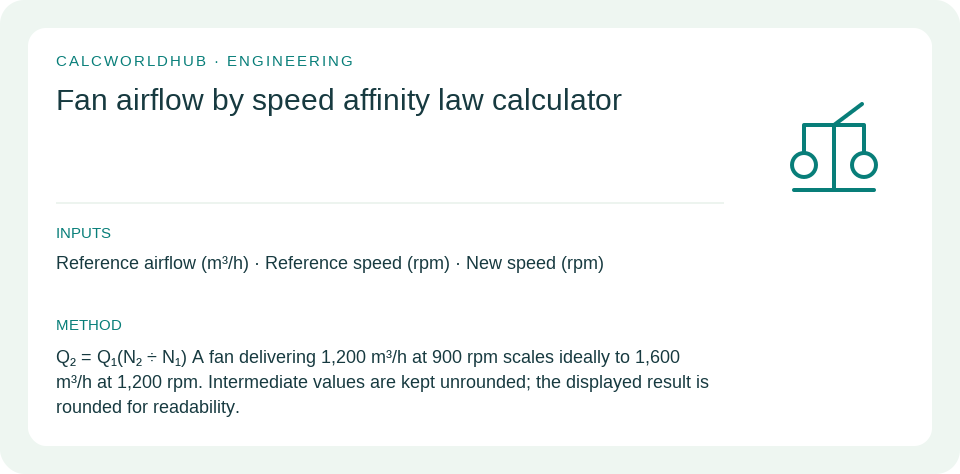
How to use this calculator
Scale a fan airflow estimate for a changed rotational speed under similar conditions.
- Enter Reference airflow (m³/h), Reference speed (rpm), New speed (rpm). Match the units shown beside each field and review the result together with the assumptions below.
- Read the worked example below to check the expected input format and result.
- Compare another scenario by changing one input at a time. Use Reset to return to the starting values.
Define the component and operating point
Estimate volume flow at a new fan speed while holding fan geometry and comparable conditions fixed. Scale a fan airflow estimate for a changed rotational speed under similar conditions.
Inputs and units
Enter reference airflow and both fan speeds; all airflow measurements must use the same unit and speeds the same rpm basis.
- Reference airflow (m³/h): Baseline volume flow Q₁ at the reference fan speed; the result uses this same airflow unit.
- Reference speed (rpm): Baseline rotational speed N₁ in rpm; it must be positive for the speed ratio.
- New speed (rpm): Target rotational speed N₂ in rpm for the ideal scaled airflow estimate.
Design equation and example
Q₂ = Q₁(N₂ ÷ N₁)
A fan delivering 1,200 m³/h at 900 rpm scales ideally to 1,600 m³/h at 1,200 rpm.
Intermediate values are kept unrounded; the displayed result is rounded for readability.
Applying the result in a system
The result is ideal volume flow at N₂. In a connected duct, the fan curve, damper position, system resistance, and air density set the actual operating point.
Assumptions and limitations
Ideal similarity estimate; duct resistance, density, and fan control can change the actual operating point.
Frequently asked questions
How does fan airflow scale with rotational speed?
Under the fan affinity laws and similar operating conditions, airflow varies directly with speed: Q₂=Q₁(N₂/N₁).
When can installed airflow differ from this estimate?
Duct resistance, damper position, air density, fan control, and the fan curve can move the operating point away from the ideal similarity estimate.
How is airflow scaling different from pressure or power scaling?
For the same fan and comparable conditions, pressure scales approximately with speed squared and shaft power with speed cubed; airflow scales linearly.
How do I use the Fan airflow by speed affinity law calculator?
Enter Reference airflow (m³/h), Reference speed (rpm), New speed (rpm). Match the units shown beside each field and review the result together with the assumptions below.
What is a worked example of Fan airflow by speed affinity law?
Q₂ = Q₁(N₂ ÷ N₁) A fan delivering 1,200 m³/h at 900 rpm scales ideally to 1,600 m³/h at 1,200 rpm. Intermediate values are kept unrounded; the displayed result is rounded for readability.
Read the calculation methodology and privacy policy.