Fan power by speed affinity law calculator
Estimate fan shaft power change from a change in rotational speed. Enter your values below to see the result and method.
inputs.
Related calculators
Compare fan shaft power with airflow and pressure scaling, or estimate power from an operating airflow and pressure.
How to use this calculator
Free Fan power by speed affinity law calculator. Estimate fan shaft power change from a change in rotational speed. Formula, example, and assumptions explained.
- Enter Reference shaft power (kW), Reference speed (rpm), New speed (rpm). Match the units shown beside each field and review the result together with the assumptions below.
- Read the worked example below to check the expected input format and result.
- Compare another scenario by changing one input at a time. Use Reset to return to the starting values.
Define the component and operating point
Estimate fan shaft load at a changed rotational speed; it does not convert that load to electrical input power. Estimate fan shaft power change from a change in rotational speed.
Inputs and units
Enter reference shaft power and both speeds; the result estimates shaft power at the new rpm.
- Reference shaft power (kW): Baseline mechanical power delivered at the fan shaft, before motor and drive losses.
- Reference speed (rpm): Baseline rotational speed N₁ in rpm; it must be positive for the speed ratio.
- New speed (rpm): Target rotational speed N₂ in rpm for the ideal shaft-power estimate.
Design equation and example
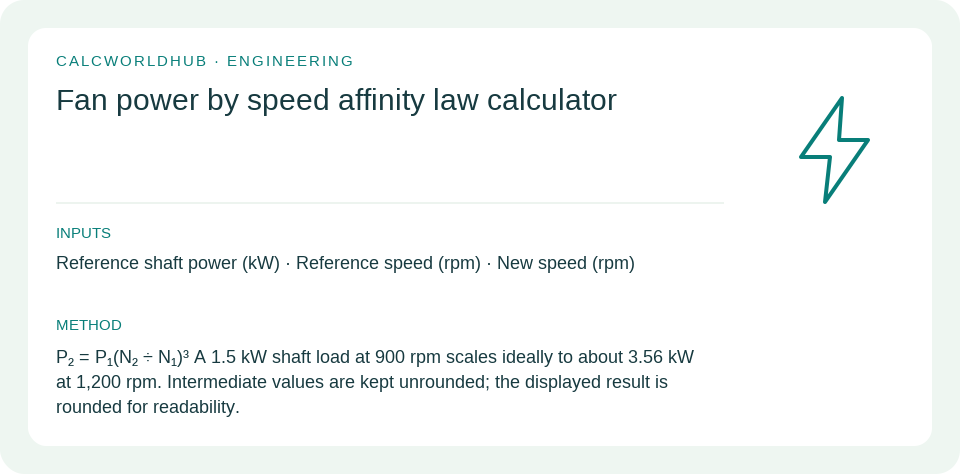
P₂ = P₁(N₂ ÷ N₁)³
A 1.5 kW shaft load at 900 rpm scales ideally to about 3.56 kW at 1,200 rpm.
Intermediate values are kept unrounded; the displayed result is rounded for readability.
Applying the result in a system
The result is ideal shaft power at N₂. Motor and drive efficiency are needed for electrical input, and the system curve can shift the fan duty point.
Assumptions and limitations
Approximate fan law for similar operating conditions; drive and motor efficiency are additional.
Frequently asked questions
How does fan shaft power scale with speed?
For the same fan under similar conditions, shaft power varies approximately with the cube of rotational speed: P₂=P₁(N₂/N₁)³.
Is the result electrical input power?
Not necessarily. The formula scales fan shaft power. Motor and drive efficiency are needed to estimate electrical input.
Why can a real fan require more or less power?
Air density, system resistance, fan efficiency, control strategy, and movement along the fan curve affect actual operating power.
How do I use the Fan power by speed affinity law calculator?
Enter Reference shaft power (kW), Reference speed (rpm), New speed (rpm). Match the units shown beside each field and review the result together with the assumptions below.
What is a worked example of Fan power by speed affinity law?
P₂ = P₁(N₂ ÷ N₁)³ A 1.5 kW shaft load at 900 rpm scales ideally to about 3.56 kW at 1,200 rpm. Intermediate values are kept unrounded; the displayed result is rounded for readability.
Read the calculation methodology and privacy policy.