Fan pressure by speed affinity law calculator
Estimate fan pressure change when rotational speed changes while fan geometry remains constant. Enter your values below to see the result and method.
inputs.
Related calculators
Compare pressure with airflow and shaft-power scaling, or estimate power from fan airflow and pressure.
How to use this calculator
Estimate fan pressure change when rotational speed changes while fan geometry remains constant.
- Enter Reference pressure (Pa), Reference speed (rpm), New speed (rpm). Match the units shown beside each field and review the result together with the assumptions below.
- Read the worked example below to check the expected input format and result.
- Compare another scenario by changing one input at a time. Use Reset to return to the starting values.
Define the component and operating point
Estimate how the same fan's pressure rise changes with speed under comparable density and operating conditions. Estimate fan pressure change when rotational speed changes while fan geometry remains constant.
Inputs and units
Enter reference pressure in pascals and reference/new fan speeds in rpm, keeping density and fan configuration comparable.
- Reference pressure (Pa): Baseline pressure rise across the fan at reference speed N₁.
- Reference speed (rpm): Baseline rotational speed N₁ in rpm; it must be positive for the speed ratio.
- New speed (rpm): Target rotational speed N₂ in rpm; at similar conditions pressure scales with (N₂/N₁)².
Design equation and example
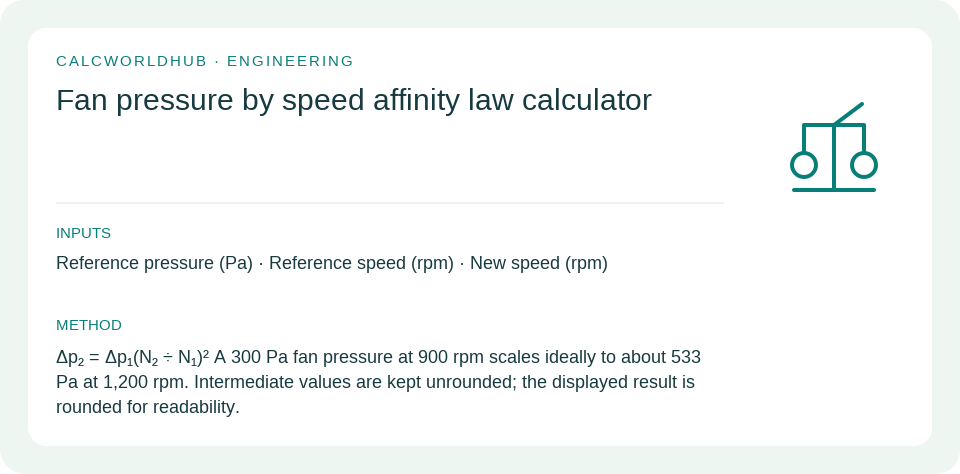
Δp₂ = Δp₁(N₂ ÷ N₁)²
A 300 Pa fan pressure at 900 rpm scales ideally to about 533 Pa at 1,200 rpm.
Intermediate values are kept unrounded; the displayed result is rounded for readability.
Applying the result in a system
The result is an ideal pressure-rise scaling estimate. System resistance, air density, fan geometry, and operating point affect measured pressure.
Assumptions and limitations
Uses the fan pressure affinity relationship at similar density and operating conditions.
Frequently asked questions
How does fan pressure scale with speed?
Under similar fan conditions, pressure varies approximately with the square of rotational speed: Δp₂=Δp₁(N₂/N₁)².
What pressure does the estimate represent?
It scales the entered reference fan pressure using the affinity relationship. It does not solve the connected duct system’s operating point.
Which conditions should remain similar?
Fan geometry and air density should be comparable; system resistance, dampers, controls, and efficiency can alter actual pressure.
How do I use the Fan pressure by speed affinity law calculator?
Enter Reference pressure (Pa), Reference speed (rpm), New speed (rpm). Match the units shown beside each field and review the result together with the assumptions below.
What is a worked example of Fan pressure by speed affinity law?
Δp₂ = Δp₁(N₂ ÷ N₁)² A 300 Pa fan pressure at 900 rpm scales ideally to about 533 Pa at 1,200 rpm. Intermediate values are kept unrounded; the displayed result is rounded for readability.
Read the calculation methodology and privacy policy.