How to use this calculator
Estimate first-order secular node and periapsis precession from oblateness, or solve the inclination for a requested nodal rate.
- Enter Semi-major axis (km), Eccentricity, Inclination for forward mode (degrees), Dimensionless positive J2, then complete the remaining labeled fields. Match the units shown beside each field and review the result together with the assumptions below.
- Read the worked example below to check the expected input format and result.
- Compare another scenario by changing one input at a time. Use Reset to return to the starting values.
First order J2 orbital precession and inclination explained
Use Semi-major axis (km) with Eccentricity to reproduce the sample calculation, then review the stated limits before carrying the result into another scenario.
A numerical walkthrough
Semi-major axis (km) = 7078; Eccentricity = 0.001; Inclination for forward mode (degrees) = 98; Dimensionless positive J2 = 0.001083; Reference equatorial radius (km) = 6378.137; Gravitational parameter (km^3/s^2) = 398600.4418; Desired nodal precession for solve mode (degrees/day) = 0.985647; Calculation direction = forward.
- Secular nodal precession: 0.963234774 degrees/day
- Secular argument of periapsis precession: -3.125422816 degrees/day
- Inclination used: 98 degrees
- Unperturbed Kepler period: 5926.20701103 s
The near-polar retrograde example can have positive node precession even though prograde inclinations usually give negative precession for positive J2.
The model behind the numbers
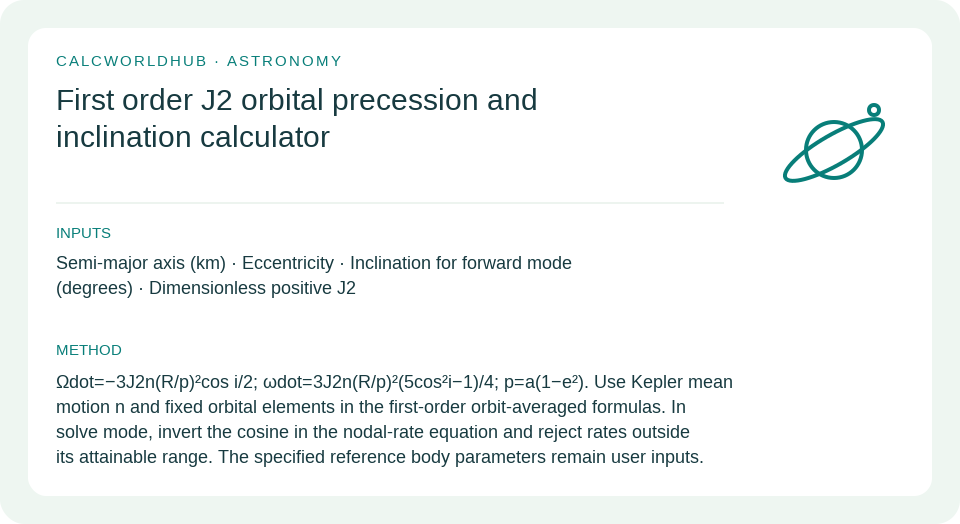
Ωdot=−3J2n(R/p)²cos i/2; ωdot=3J2n(R/p)²(5cos²i−1)/4; p=a(1−e²).
Use Kepler mean motion n and fixed orbital elements in the first-order orbit-averaged formulas. In solve mode, invert the cosine in the nodal-rate equation and reject rates outside its attainable range. The specified reference body parameters remain user inputs.
What to enter
a— Semi-major axis (km)- Length measured in kilometres.
e— Eccentricity- Eccentricity. This is a dimensionless model parameter unless the label explicitly states a unit.
i— Inclination for forward mode (degrees)- Angle in degrees, converted internally to radians.
J2— Dimensionless positive J2- Dimensionless positive J2. This is a dimensionless model parameter unless the label explicitly states a unit.
R— Reference equatorial radius (km)- Length measured in kilometres.
mu— Gravitational parameter (km^3/s^2)- Positive central-body parameter G times mass, in km³/s².
target— Desired nodal precession for solve mode (degrees/day)- Requested average node rate in degrees per 86,400-second day. Used only by solve mode.
mode— Calculation direction- Forward mode uses entered inclination. Solve mode inverts the nodal-rate relation for inclination and ignores the entered i. Choose forward, solve.
Interpreting the result
Small-J2 secular approximation for an external bound orbit. No short-period oscillations, drag, higher harmonics, third bodies, resonance, or maneuver effects. Periapsis angle is physically degenerate for a perfectly circular orbit.
Reading the outputs
Rates are degrees per 86,400-second day. They are orbit-averaged model rates, not a high-fidelity ephemeris.
Frequently asked questions
Does solve mode guarantee a Sun-synchronous mission?
No. It matches only the entered average node rate in this simplified model.
Why can a requested rate be impossible?
The cosine of inclination is bounded between minus one and one.
Is a surface altitude accepted as a?
No. Enter semi-major axis from the center.
How do I use the First order J2 orbital precession and inclination calculator?
Enter Semi-major axis (km), Eccentricity, Inclination for forward mode (degrees), Dimensionless positive J2, then complete the remaining labeled fields. Match the units shown beside each field and review the result together with the assumptions below.
What is a worked example of First order J2 orbital precession and inclination?
Semi-major axis (km) = 7078; Eccentricity = 0.001; Inclination for forward mode (degrees) = 98; Dimensionless positive J2 = 0.001083; Reference equatorial radius (km) = 6378.137; Gravitational parameter (km^3/s^2) = 398600.4418; Desired nodal precession for solve mode (degrees/day) = 0.985647; Calculation direction = forward. Secular nodal precession: 0.963234774 degrees/day Secular argument of periapsis precession: -3.125422816 degrees/day Inclination used: 98 degrees Unperturbed Kepler period: 5926.20701103 s The near-polar retrograde example can have positive node precession even though prograde inclinations usually give negative precession for positive J2.
Background or definition reference: NASA J2 secular orbit-precession equations.
Read our calculation methodology.