How to use this calculator
Recover eccentricity, orbital size, orientation, and true anomaly from a nonradial two-body position and velocity state.
- Enter Inertial position xyz (km), Inertial velocity xyz (km/s), Central gravitational parameter (km^3/s^2). Match the units shown beside each field and review the result together with the assumptions below.
- Read the worked example below to check the expected input format and result.
- Compare another scenario by changing one input at a time. Use Reset to return to the starting values.
Orbital elements from Cartesian state vectors explained
How the calculation works
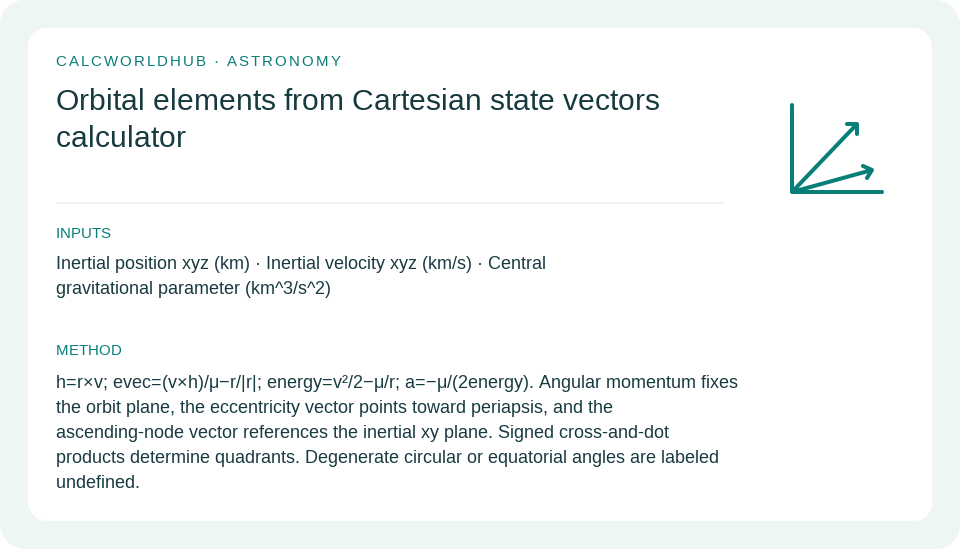
h=r×v; evec=(v×h)/μ−r/|r|; energy=v²/2−μ/r; a=−μ/(2energy).
Angular momentum fixes the orbit plane, the eccentricity vector points toward periapsis, and the ascending-node vector references the inertial xy plane. Signed cross-and-dot products determine quadrants. Degenerate circular or equatorial angles are labeled undefined.
Set up the calculation
r— Inertial position xyz (km)- Three inertial position components in kilometres from the central body’s center. Use comma-separated values in the stated order.
v— Inertial velocity xyz (km/s)- Three inertial velocity components in km/s in the same reference frame as r. Use comma-separated values in the stated order.
mu— Central gravitational parameter (km^3/s^2)- Positive central-body parameter G times mass, in km³/s².
Limits of this model
Point-mass two-body dynamics in one consistent inertial frame. No reference-body collision check or perturbations. Radial states are excluded. Near-parabolic size and circular/equatorial orientation require limiting conventions.
Check this example
Inertial position xyz (km) = 7000,1000,2000; Inertial velocity xyz (km/s) = -1,7,1; Central gravitational parameter (km^3/s^2) = 398600.4418.
- Orbital eccentricity: 0.0708586175
- Semi-major axis: 6933.95436201 km
- Inclination: 17.54840061 degrees
- Ascending node longitude: 304.695154 degrees
- Argument of periapsis: 274.864193 degrees
- True anomaly: 149.647208 degrees
- Specific orbital energy: -28.74264965 km^2/s^2
The three-dimensional state has nonzero z position and velocity, so inclination and node orientation must come from vectors rather than a planar vis-viva calculation alone.
Reading the outputs
Semi-major axis is negative for a hyperbolic state. Undefined periapsis angles in a circular orbit are geometric degeneracies, not calculation failures.
Frequently asked questions
Must position and velocity use the same frame?
Yes. Mixing Earth-fixed and inertial components gives invalid elements.
Why is true anomaly undefined for a circle?
There is no unique periapsis direction from which to measure it.
Are these osculating elements?
For a supplied perturbed state they describe the instantaneous matching two-body conic, without predicting perturbations.
How do I use the Orbital elements from Cartesian state vectors calculator?
Enter Inertial position xyz (km), Inertial velocity xyz (km/s), Central gravitational parameter (km^3/s^2). Match the units shown beside each field and review the result together with the assumptions below.
What is a worked example of Orbital elements from Cartesian state vectors?
Inertial position xyz (km) = 7000,1000,2000; Inertial velocity xyz (km/s) = -1,7,1; Central gravitational parameter (km^3/s^2) = 398600.4418. Orbital eccentricity: 0.0708586175 Semi-major axis: 6933.95436201 km Inclination: 17.54840061 degrees Ascending node longitude: 304.695154 degrees Argument of periapsis: 274.864193 degrees True anomaly: 149.647208 degrees Specific orbital energy: -28.74264965 km^2/s^2 The three-dimensional state has nonzero z position and velocity, so inclination and node orientation must come from vectors rather than a planar vis-viva calculation alone.
Background or definition reference: NASA JPL SPICE conic-state documentation.
Read our calculation methodology.