How to use this calculator
Estimate dimensionless thermal diffusion time from diffusivity, elapsed time, and a chosen length scale.
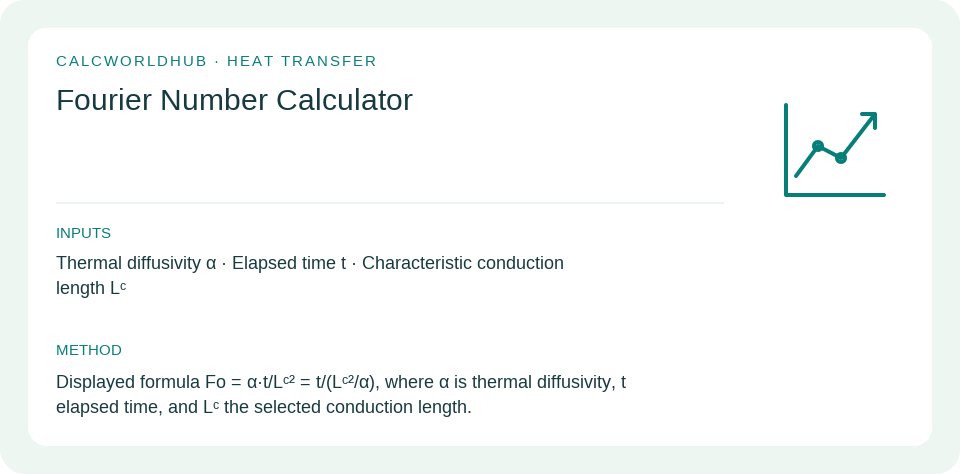
- Enter Thermal diffusivity α, Elapsed time t, Characteristic conduction length Lᶜ. Match the units shown beside each field and review the result together with the assumptions below.
- Read the worked example below to check the expected input format and result.
- Compare another scenario by changing one input at a time. Use Reset to return to the starting values.
How this calculation works
The Fourier number compares elapsed time with the time needed for heat to diffuse over a characteristic length. It appears in transient-conduction analysis as a compact way to describe how far a process has progressed, while leaving the actual temperature field to a geometry- and boundary-condition-specific model.
Inputs and units
thermalDiffusivity— Thermal diffusivity α- Material thermal diffusivity in square metres per second (m²/s).
elapsedTime— Elapsed time t- Elapsed heating or cooling time in seconds (s); zero is allowed for the initial instant.
characteristicLength— Characteristic conduction length Lᶜ- Length scale for heat diffusion in metres (m). Use the geometry's appropriate conduction length.
Formula
Fo = α·t/Lᶜ² = t/(Lᶜ²/α), where α is thermal diffusivity, t elapsed time, and Lᶜ the selected conduction length.
Method
Enter thermal diffusivity α in m²/s, elapsed time t in seconds, and characteristic conduction length Lᶜ in metres. The calculator also reports the diffusion time scale Lᶜ²/α in seconds. Both Fo and the time-scale ratio are dimensionless relationships; the reported time scale itself has units of seconds.
Worked example
For α = 1.2 × 10⁻⁵ m²/s, t = 300 s, and Lᶜ = 0.020 m, the diffusion time scale is 0.020² / 1.2 × 10⁻⁵ ≈ 33.33 s and Fo = 300 / 33.33 ≈ 9.00.
Assumptions and limits
Fourier number alone does not predict a temperature change. Geometry, initial temperature, boundary conditions, heat-transfer coefficients, and material properties determine a transient solution. This estimate assumes a constant diffusivity and one representative length scale.
Frequently asked questions
What does a larger Fourier number mean?
It means more elapsed time relative to the selected diffusion time scale, not a particular temperature or percentage of heating completed.
How is the characteristic length chosen?
Use the conduction length relevant to the geometry and boundary conditions in the transient model. Different choices change Fo, so state the convention when comparing results.
Can Fourier number be used by itself to predict temperature?
No. It is a dimensionless time parameter. A temperature solution also needs geometry, initial conditions, boundary conditions, and usually the Biot number when surface convection is involved.
Can I enter thermal diffusivity in mm²/s?
Convert it to m²/s first. For example, 1 mm²/s equals 1 × 10⁻⁶ m²/s.
How do I use the Fourier Number Calculator?
Enter Thermal diffusivity α, Elapsed time t, Characteristic conduction length Lᶜ. Match the units shown beside each field and review the result together with the assumptions below.
Reference: University of Waterloo conduction heat-transfer notes defining Biot and Fourier numbers. See our calculation methodology.