How to use this calculator
Estimate headwater elevation for a fully submerged circular culvert by combining entrance, barrel friction and exit losses.
- Enter Culvert discharge (m³/s), Circular barrel diameter (m), Barrel length (m), Darcy friction factor, then complete the remaining labeled fields. Match the units shown beside each field and review the result together with the assumptions below.
- Read the worked example below to check the expected input format and result.
- Compare another scenario by changing one input at a time. Use Reset to return to the starting values.
Full flowing culvert outlet control headwater explained
Use Culvert discharge (m³/s) with Circular barrel diameter (m) to reproduce the sample calculation, then review the stated limits before carrying the result into another scenario.
How the calculation works
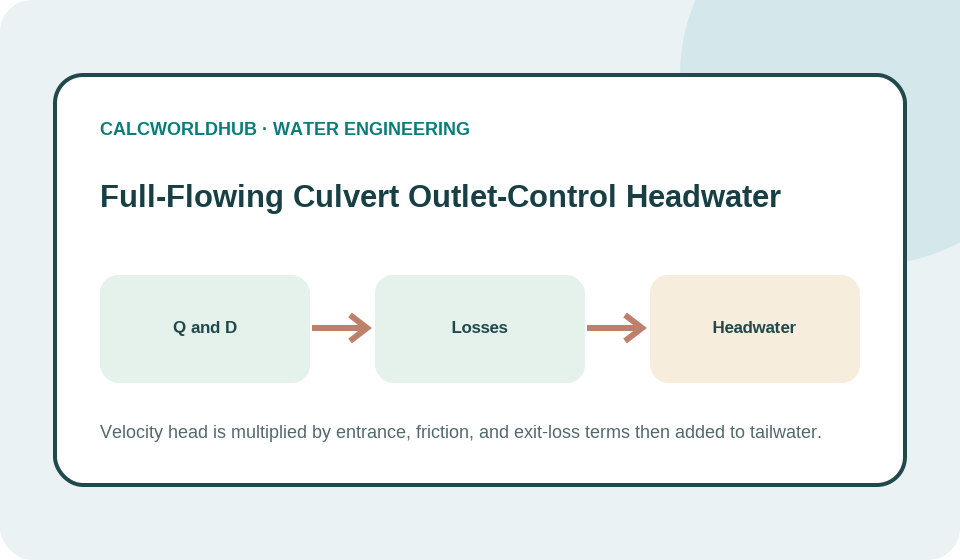
HW=TW+(Ke+fL/D+Kexit)V²/(2g), V=4Q/(πD²), with Kexit=1 into a large downstream pool.
The upstream and downstream pools have negligible approach velocity. The calculation assumes a full barrel and downstream submergence before applying outlet-control energy balance.
Set up the calculation
Q— Culvert discharge (m³/s)- Steady full-barrel discharge.
D— Circular barrel diameter (m)- Internal diameter of the full culvert.
L— Barrel length (m)- Length over which Darcy barrel friction acts.
f— Darcy friction factor- Darcy factor, not Fanning factor.
Ke— Entrance loss coefficient- Entrance loss referred to barrel velocity head.
zout— Outlet centre elevation (m)- Barrel centreline elevation on the common datum. It is used to validate full submergence (tailwater must be at least zout + D/2); because the tailwater elevation already uses this datum, zout is not added again to the computed headwater.
TW— Tailwater surface elevation (m)- Downstream water surface; it must submerge the outlet crown for this full-flow model.
Limits of this model
Full-flow outlet control only. Inlet control, unsubmerged outlet, air entrainment, debris, barrel transitions and roadway overtopping require other calculations. Educational model; this is not a code-compliant design check.
Check this example
Culvert discharge (m³/s) = 2; Circular barrel diameter (m) = 1; Barrel length (m) = 30; Darcy friction factor = 0.025; Entrance loss coefficient = 0.5; Outlet centre elevation (m) = 0; Tailwater surface elevation (m) = 1.
- Required upstream water elevation: 1.743896 m datum
- Total hydraulic loss: 0.743896 m
- Barrel mean velocity: 2.546479 m/s
A 1 m diameter, 30 m culvert carries 2 m³/s with f=0.025 and entrance coefficient 0.5 into tailwater elevation 1 m above the outlet centre datum.
Reading the outputs
Upstream water elevation uses the same datum as tailwater; total loss is m and barrel velocity is m/s.
Frequently asked questions
Is the higher of inlet and outlet control checked?
No. This page only supplies the submerged outlet-control branch.
Why include an exit coefficient of one?
The full barrel discharges into a large pool where its kinetic energy is dissipated under this idealization.
Can tailwater be below the outlet crown?
Not for this model; that condition is rejected instead of applying a full-flow equation blindly.
How do I use the Full flowing culvert outlet control headwater calculator?
Enter Culvert discharge (m³/s), Circular barrel diameter (m), Barrel length (m), Darcy friction factor, then complete the remaining labeled fields. Match the units shown beside each field and review the result together with the assumptions below.
What is a worked example of Full flowing culvert outlet control headwater?
Culvert discharge (m³/s) = 2; Circular barrel diameter (m) = 1; Barrel length (m) = 30; Darcy friction factor = 0.025; Entrance loss coefficient = 0.5; Outlet centre elevation (m) = 0; Tailwater surface elevation (m) = 1. Required upstream water elevation: 1.743896 m datum Total hydraulic loss: 0.743896 m Barrel mean velocity: 2.546479 m/s A 1 m diameter, 30 m culvert carries 2 m³/s with f=0.025 and entrance coefficient 0.5 into tailwater elevation 1 m above the outlet centre datum.
Background or definition reference: USACE HEC-RAS Hydraulic Reference Manual.
Reference access note: The linked HEC-RAS reference PDF was not retrievable during this review. The stated equation and numerical example were checked independently; verify against current official hydraulic guidance before design use.
Read our calculation methodology.