How to use this calculator
Estimate Gaussian antenna pointing loss, remaining gain, and offset tolerance from beamwidth.
- Enter Full half-power beamwidth (degrees), Pointing offset from beam center (degrees), Allowed pointing loss (dB). Match the units shown beside each field and review the result together with the assumptions below.
- Read the worked example below to check the expected input format and result.
- Compare another scenario by changing one input at a time. Use Reset to return to the starting values.
Compare pointing loss with a Gaussian beamwidth tolerance
This educational Gaussian approximation estimates loss at a specified off-axis pointing error and also computes the offset limit for a chosen loss budget. Both results use the full half-power beamwidth.
Inputs and units
- Full half-power beamwidth (degrees): Full angular width between the two half-power points, not the half-width.
- Pointing offset from beam center (degrees): Magnitude of angular misalignment from boresight.
- Allowed pointing loss (dB): Maximum loss budget relative to the peak beam gain; used to calculate a permissible offset.
Formula and method
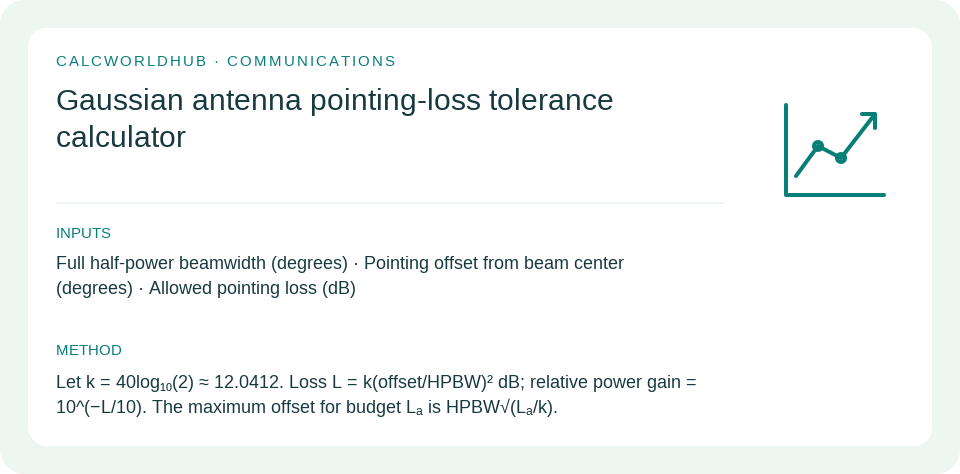
Let k = 40log₁₀(2) ≈ 12.0412. Loss L = k(offset/HPBW)² dB; relative power gain = 10^(−L/10). The maximum offset for budget Lₐ is HPBW√(Lₐ/k).
Worked example
For HPBW = 2°, offset = 0.3°, and a 1 dB budget, loss ≈ 0.2709 dB, relative power gain ≈ 0.9395, and maximum offset ≈ 0.5764°.
Interpreting the result
At the entered offset the simplified model retains about 93.95% of peak power gain. The 1 dB budget corresponds to an offset limit of about 0.576° in this symmetric pattern model.
Assumptions and limits
The Gaussian pattern is an approximation, not an antenna-specific measured pattern or a regulatory pointing requirement. It omits sidelobes, asymmetry, polarization, feed loss, and other link-budget terms.
Method references
Frequently asked questions
Is the entered beamwidth a half-angle?
No. Enter the full width between the half-power points. The model’s loss factor is defined for that full HPBW.
How do I use the Gaussian antenna pointing-loss tolerance calculator?
Enter Full half-power beamwidth (degrees), Pointing offset from beam center (degrees), Allowed pointing loss (dB). Match the units shown beside each field and review the result together with the assumptions below.
What is a worked example of Gaussian antenna pointing-loss tolerance?
For HPBW = 2°, offset = 0.3°, and a 1 dB budget, loss ≈ 0.2709 dB, relative power gain ≈ 0.9395, and maximum offset ≈ 0.5764°.
What does the Gaussian antenna pointing-loss tolerance calculator calculate?
Estimate Gaussian antenna pointing loss, remaining gain, and offset tolerance from beamwidth.
What assumptions apply to Gaussian antenna pointing-loss tolerance?
The Gaussian pattern is an approximation, not an antenna-specific measured pattern or a regulatory pointing requirement. It omits sidelobes, asymmetry, polarization, feed loss, and other link-budget terms.