How to use this calculator
Translate an average laser power reading into pulse energy, Gaussian peak power and peak spatial fluence.
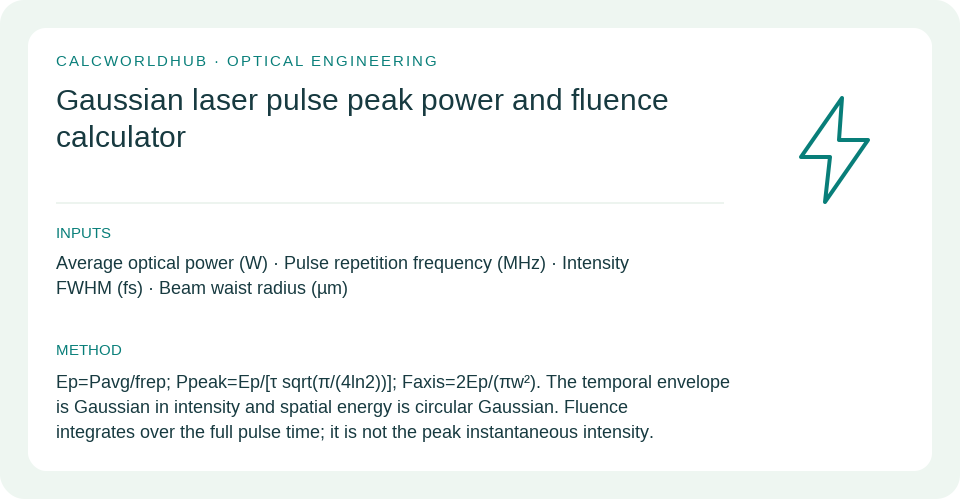
- Enter Average optical power (W), Pulse repetition frequency (MHz), Intensity FWHM (fs), Beam waist radius (µm). Match the units shown beside each field and review the result together with the assumptions below.
- Read the worked example below to check the expected input format and result.
- Compare another scenario by changing one input at a time. Use Reset to return to the starting values.
Gaussian laser pulse peak power and fluence explained
Use Average optical power (W) with Pulse repetition frequency (MHz) to reproduce the sample calculation, then review the stated limits before carrying the result into another scenario.
A numerical walkthrough
Average optical power (W) = 2; Pulse repetition frequency (MHz) = 80; Intensity FWHM (fs) = 100; Beam waist radius (µm) = 20.
- Peak pulse power: 234859.319675 W
- Energy per pulse: 25 nJ
- On axis pulse fluence: 0.003979 J/cm²
A 2 W, 80 MHz train carries 25 nJ per pulse. A 100 fs Gaussian duration gives peak power near 235 kW.
The model behind the numbers
Ep=Pavg/frep; Ppeak=Ep/[τ sqrt(π/(4ln2))]; Faxis=2Ep/(πw²).
The temporal envelope is Gaussian in intensity and spatial energy is circular Gaussian. Fluence integrates over the full pulse time; it is not the peak instantaneous intensity.
What to enter
average— Average optical power (W)- Time-averaged power of a uniform pulse train.
rate— Pulse repetition frequency (MHz)- Number of identical pulses per microsecond.
duration— Intensity FWHM (fs)- Temporal full width at half peak intensity.
radius— Beam waist radius (µm)- Spatial Gaussian 1/e² intensity radius.
Interpreting the result
Identical isolated pulses, no pedestal and Gaussian profiles. No material damage threshold or safety classification follows from these numbers.
Reading the outputs
Peak power is W, pulse energy is nJ and on-axis time-integrated fluence is J/cm².
Frequently asked questions
Can I compare fluence directly with a damage specification?
Only after matching wavelength, pulse duration, repetition rate and the vendor definition of beam size.
Why is Gaussian peak power below energy divided by FWHM?
Energy also lies outside the FWHM interval.
Does doubling the spot radius halve fluence?
It reduces on-axis fluence by a factor of four.
How do I use the Gaussian laser pulse peak power and fluence calculator?
Enter Average optical power (W), Pulse repetition frequency (MHz), Intensity FWHM (fs), Beam waist radius (µm). Match the units shown beside each field and review the result together with the assumptions below.
What is a worked example of Gaussian laser pulse peak power and fluence?
Average optical power (W) = 2; Pulse repetition frequency (MHz) = 80; Intensity FWHM (fs) = 100; Beam waist radius (µm) = 20. Peak pulse power: 234859.319675 W Energy per pulse: 25 nJ On axis pulse fluence: 0.003979 J/cm² A 2 W, 80 MHz train carries 25 nJ per pulse. A 100 fs Gaussian duration gives peak power near 235 kW.
Background or definition reference: MIT Ultrafast Optics, pulse propagation and characterization.
Read our calculation methodology.