General union probability calculator
Calculate the chance that at least one of two events occurs when their overlap is known.
How to use this calculator
Calculate the chance that at least one of two events occurs when their overlap is known.
- Enter P(A), P(B), P(A and B). Match the units shown beside each field and review the result together with the assumptions below.
- Read the worked example below to check the expected input format and result.
- Compare another scenario by changing one input at a time. Use Reset to return to the starting values.
How the General union probability calculator works
Calculate the chance that at least one of two events occurs when their overlap is known.
Inputs and units
- P(A): P(A) is the probability of event A, from 0 to 1.
- P(B): P(B) is the probability of event B, from 0 to 1.
- P(A and B): P(A and B) is their joint probability and must satisfy the probability bounds.
Formula and method
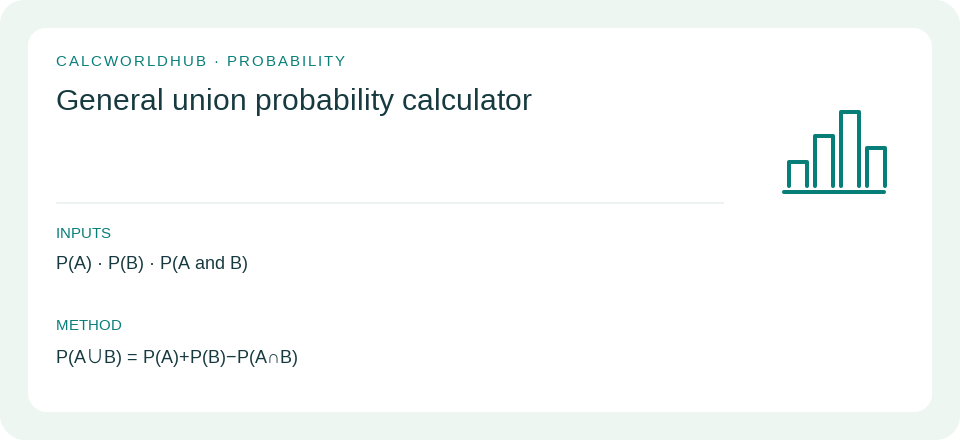
P(A∪B) = P(A)+P(B)−P(A∩B)
Worked example
If P(A)=0.4, P(B)=0.5, and P(A∩B)=0.2, then P(A∪B)=0.7.
Interpreting the result
The overlap is subtracted once because outcomes in both A and B were counted twice in the sum.
Assumptions and limits
Each input must describe the same probability model. The joint probability must lie between max(0,P(A)+P(B)−1) and min(P(A),P(B)).
Sources and method
- Explains inclusion–exclusion for the union of two events. OpenStax Contemporary Mathematics: Addition rule for probability
Frequently asked questions
When can I add P(A) and P(B) without subtracting overlap?
Only when the events are mutually exclusive and their joint probability is zero.
Must the events be independent?
No. Enter their actual joint probability; independence is not assumed.
How do I use the General union probability calculator?
Enter P(A), P(B), P(A and B). Match the units shown beside each field and review the result together with the assumptions below.
What is a worked example of General union probability?
If P(A)=0.4, P(B)=0.5, and P(A∩B)=0.2, then P(A∪B)=0.7.
What does the General union probability calculator calculate?
Calculate the chance that at least one of two events occurs when their overlap is known.
See the calculation methodology.