How to use this calculator
Compare an ideal grating diffraction separation with the spectral width caused by a finite projected slit.
- Enter Vacuum wavelength (nm), Grating groove density (per mm), Illuminated ruled width (mm), Positive diffraction order, then complete the remaining labeled fields. Match the units shown beside each field and review the result together with the assumptions below.
- Read the worked example below to check the expected input format and result.
- Compare another scenario by changing one input at a time. Use Reset to return to the starting values.
Grating spectrometer slit and diffraction resolution explained
Compare an ideal grating diffraction separation with the spectral width caused by a finite projected slit.
How the calculation works
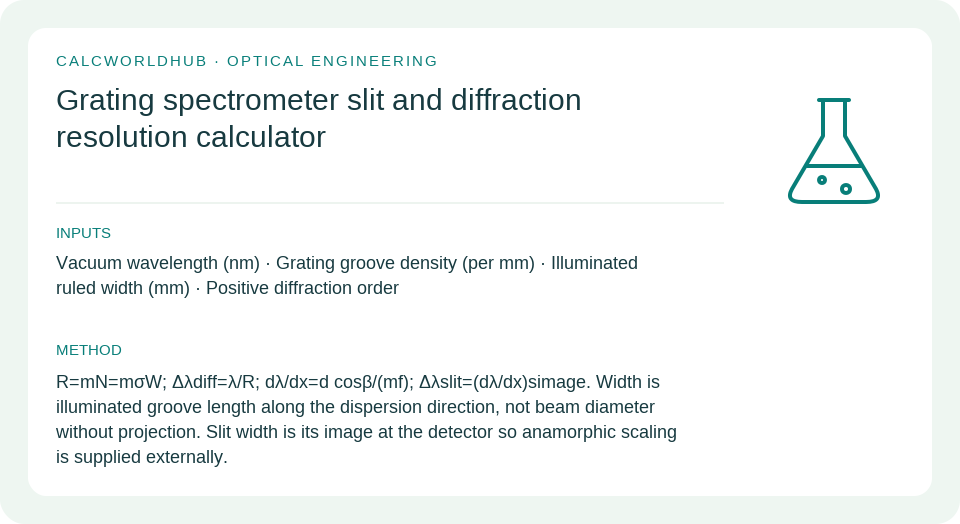
R=mN=mσW; Δλdiff=λ/R; dλ/dx=d cosβ/(mf); Δλslit=(dλ/dx)simage.
Width is illuminated groove length along the dispersion direction, not beam diameter without projection. Slit width is its image at the detector so anamorphic scaling is supplied externally.
Set up the calculation
wavelength— Vacuum wavelength (nm)- Monochromatic vacuum wavelength in nanometres.
density— Grating groove density (per mm)- Uniform groove density over the illuminated ruled width.
width— Illuminated ruled width (mm)- Width measured along the grating surface perpendicular to grooves.
order— Positive diffraction order- Spectral diffraction order. Enter a whole number.
focal— Camera focal length (mm)- Image-side monochromator focal length.
angle— Diffraction angle (degrees)- Output angle relative to grating normal.
slit— Projected image slit width (µm)- Entrance slit image width at the detector, including anamorphic magnification.
Limits of this model
Ideal monochromator near one wavelength; aberrations, pixel width and line-spread convolution are excluded. The two widths are shown separately rather than combined without a justified line-shape model.
Check this example
Vacuum wavelength (nm) = 550; Grating groove density (per mm) = 1200; Illuminated ruled width (mm) = 25; Positive diffraction order = 1; Camera focal length (mm) = 200; Diffraction angle (degrees) = 20; Projected image slit width (µm) = 20.
- Diffraction limited wavelength separation: 0.018333 nm
- Slit limited wavelength width: 0.078308 nm
- Reciprocal linear dispersion: 3.915386 nm/mm
- Grating resolving power: 30000
A first-order 1200 grooves/mm grating illuminated over 25 mm has R=30000 and ideal separation 0.0183 nm at 550 nm.
Reading the outputs
Both widths are nm, reciprocal linear dispersion is nm/mm and resolving power is dimensionless.
Comparison scenario
Doubling illuminated width from 25 mm to 50 mm doubles the ruled-groove count from 30,000 to 60,000, so the ideal diffraction separation halves from 0.018333 nm to 0.009167 nm. The slit image remains 0.078308 nm wide at the same focal length and slit width, so this case is slit-limited.
Frequently asked questions
Can I simply add the two wavelength widths?
Not without choosing compatible line shapes and width definitions.
Why enter projected slit width?
The grating and relay can magnify the entrance slit asymmetrically.
Does higher resolving power guarantee that measured lines separate?
Actual slit, detector, aberration and signal-to-noise limits can dominate.
How do I use the Grating spectrometer slit and diffraction resolution calculator?
Enter Vacuum wavelength (nm), Grating groove density (per mm), Illuminated ruled width (mm), Positive diffraction order, then complete the remaining labeled fields. Match the units shown beside each field and review the result together with the assumptions below.
What is a worked example of Grating spectrometer slit and diffraction resolution?
Vacuum wavelength (nm) = 550; Grating groove density (per mm) = 1200; Illuminated ruled width (mm) = 25; Positive diffraction order = 1; Camera focal length (mm) = 200; Diffraction angle (degrees) = 20; Projected image slit width (µm) = 20. Diffraction limited wavelength separation: 0.018333 nm Slit limited wavelength width: 0.078308 nm Reciprocal linear dispersion: 3.915386 nm/mm Grating resolving power: 30000 A first-order 1200 grooves/mm grating illuminated over 25 mm has R=30000 and ideal separation 0.0183 nm at 550 nm.
Background or definition reference: HORIBA diffraction gratings handbook.
Read our calculation methodology.