How to use this calculator
Add commutation losses that a simple MOSFET on-resistance and overlap budget can miss in a synchronous half bridge.
- Enter Commutating current magnitude (A), Body-diode forward drop (V), Dead time per transition (s), Switching frequency (Hz), then complete the remaining labeled fields. Match the units shown beside each field and review the result together with the assumptions below.
- Read the worked example below to check the expected input format and result.
- Compare another scenario by changing one input at a time. Use Reset to return to the starting values.
Half-bridge diode dead-time and recovery loss explained
Use Commutating current magnitude (A) with Body-diode forward drop (V) to reproduce the sample calculation, then review the stated limits before carrying the result into another scenario.
A numerical walkthrough
Commutating current magnitude (A) = 10; Body-diode forward drop (V) = 0.9; Dead time per transition (s) = 1.00000000e-07; Switching frequency (Hz) = 100000; Recovered diode charge (C) = 3.00000000e-08; Bus voltage (V) = 48; Recovery events per cycle = 1.
- Additional bridge loss: 0.324 W
- Dead-time conduction loss: 0.18 W
- Recovery-charge loss estimate: 0.144 W
A 48 V bridge switching 10 A at 100 kHz spends 100 ns per transition in a 0.9 V diode; one 30 nC recovery adds another loss term.
The model behind the numbers
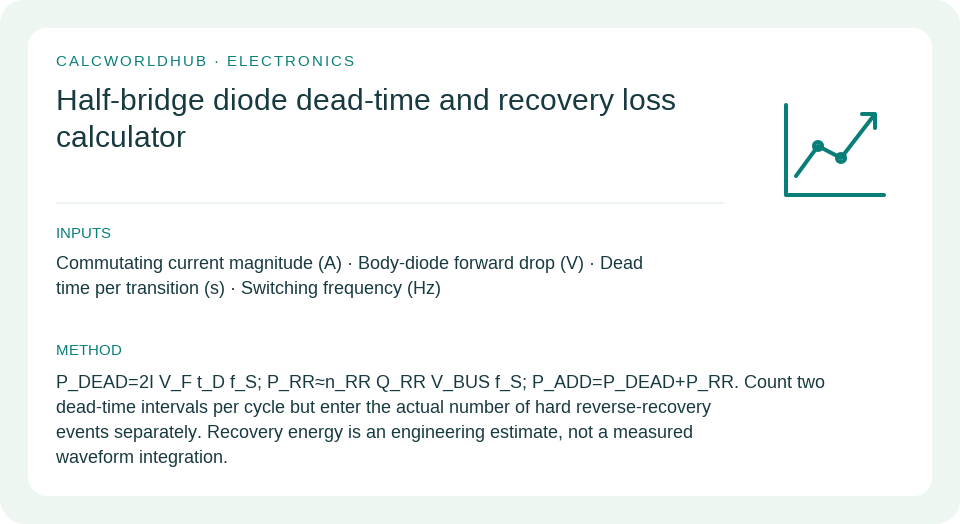
P_DEAD=2I V_F t_D f_S; P_RR≈n_RR Q_RR V_BUS f_S; P_ADD=P_DEAD+P_RR.
Count two dead-time intervals per cycle but enter the actual number of hard reverse-recovery events separately. Recovery energy is an engineering estimate, not a measured waveform integration.
What to enter
I— Commutating current magnitude (A)- Approximate constant current during both dead-time intervals.
Vf— Body-diode forward drop (V)- Forward voltage at that current and temperature.
td— Dead time per transition (s)- Body-diode conduction interval at each of two transitions.
fs— Switching frequency (Hz)- Number of complete bridge cycles per second.
Qrr— Recovered diode charge (C)- Effective reverse-recovery charge per hard-recovery event.
Vbus— Bus voltage (V)- Voltage across recovery commutation.
events— Recovery events per cycle- Count of hard recovery events represented by Qrr. Enter a whole number.
Interpreting the result
Constant-current dead time and Qrr approximation; ignores soft switching, nonlinear voltage overlap, temperature-dependent recovery and shoot-through.
Reading the outputs
Additional loss is for the represented bridge events. It should be added to conduction, overlap and gate-drive budgets without double-counting recovery already included in measured switching energy.
Frequently asked questions
Should measured Eon be combined with Qrr loss?
Check the measurement definition; Eon may already include diode recovery.
Why not set dead time to zero?
Real propagation delays can cause shoot-through unless sufficient nonoverlap is provided.
Does a GaN switch use a silicon body-diode Qrr?
No; use its actual reverse-conduction and charge behavior rather than copying a silicon parameter.
How do I use the Half-bridge diode dead-time and recovery loss calculator?
Enter Commutating current magnitude (A), Body-diode forward drop (V), Dead time per transition (s), Switching frequency (Hz), then complete the remaining labeled fields. Match the units shown beside each field and review the result together with the assumptions below.
What is a worked example of Half-bridge diode dead-time and recovery loss?
Commutating current magnitude (A) = 10; Body-diode forward drop (V) = 0.9; Dead time per transition (s) = 1.00000000e-07; Switching frequency (Hz) = 100000; Recovered diode charge (C) = 3.00000000e-08; Bus voltage (V) = 48; Recovery events per cycle = 1. Additional bridge loss: 0.324 W Dead-time conduction loss: 0.18 W Recovery-charge loss estimate: 0.144 W A 48 V bridge switching 10 A at 100 kHz spends 100 ns per transition in a 0.9 V diode; one 30 nC recovery adds another loss term.
Background or definition reference: Texas Instruments body-diode dead-time and recovery loss.
Read our calculation methodology.