Hedges’ g calculator
Estimate a pooled-standard-deviation effect size with the common approximate small-sample correction.
How to use this calculator
Estimate a pooled-standard-deviation effect size with the common approximate small-sample correction.
- Enter Group 1 mean, Group 2 mean, Group 1 SD, Group 2 SD, then complete the remaining labeled fields. Match the units shown beside each field and review the result together with the assumptions below.
- Read the worked example below to check the expected input format and result.
- Compare another scenario by changing one input at a time. Use Reset to return to the starting values.
How the Hedges’ g calculator works
Estimate a pooled-standard-deviation effect size with the common approximate small-sample correction.
Inputs and units
- Group 1 mean: Group 1 mean M₁ is the arithmetic mean in outcome units.
- Group 2 mean: Group 2 mean M₂ uses the same outcome scale as M₁.
- Group 1 SD: Group 1 SD s₁ is a sample standard deviation and must be nonnegative.
- Group 2 SD: Group 2 SD s₂ is a sample standard deviation and must be nonnegative.
- Group 1 sample size: n₁ is the whole-number sample size for group 1 and must be at least 2.
- Group 2 sample size: n₂ is the whole-number sample size for group 2 and must be at least 2.
Formula and method
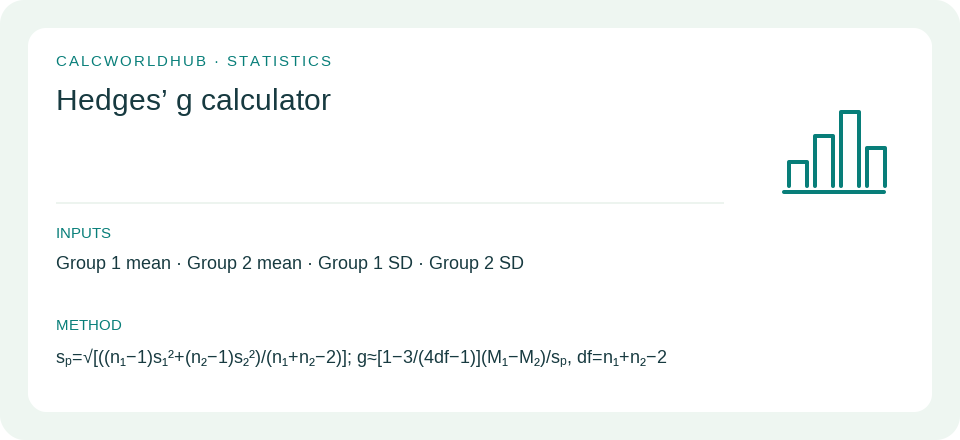
sₚ=√[((n₁−1)s₁²+(n₂−1)s₂²)/(n₁+n₂−2)]; g≈[1−3/(4df−1)](M₁−M₂)/sₚ, df=n₁+n₂−2
Worked example
For means 12 and 10, SDs 4 and 3, and n₁=n₂=25, sₚ=√12.5 and g≈0.5568.
Interpreting the result
A positive value means group 1’s mean is higher under the entered ordering; the magnitude is measured in pooled SD units.
Assumptions and limits
This is the equal-variance pooled-SD form. The J factor shown is an approximation, not the exact gamma-function correction. If both SDs are zero, standardized g is undefined.
Sources and method
- Original article on small-sample corrections for standardized mean differences; the calculator uses the common approximate J correction. Hedges (1981), Distribution Theory for Glass’s Estimator of Effect Size
Frequently asked questions
What does a negative Hedges g mean?
The first group mean is below the second under the displayed group order.
Is the small-sample correction exact?
No. The page uses the common approximation J≈1−3/(4df−1), not the exact gamma-function correction.
How do I use the Hedges’ g calculator?
Enter Group 1 mean, Group 2 mean, Group 1 SD, Group 2 SD, then complete the remaining labeled fields. Match the units shown beside each field and review the result together with the assumptions below.
What is a worked example of Hedges’ g?
For means 12 and 10, SDs 4 and 3, and n₁=n₂=25, sₚ=√12.5 and g≈0.5568.
What does the Hedges’ g calculator calculate?
Estimate a pooled-standard-deviation effect size with the common approximate small-sample correction.
See the calculation methodology.