How to use this calculator
Free Cohen’s d calculator. Standardize the difference between two group means using pooled within-group spread.
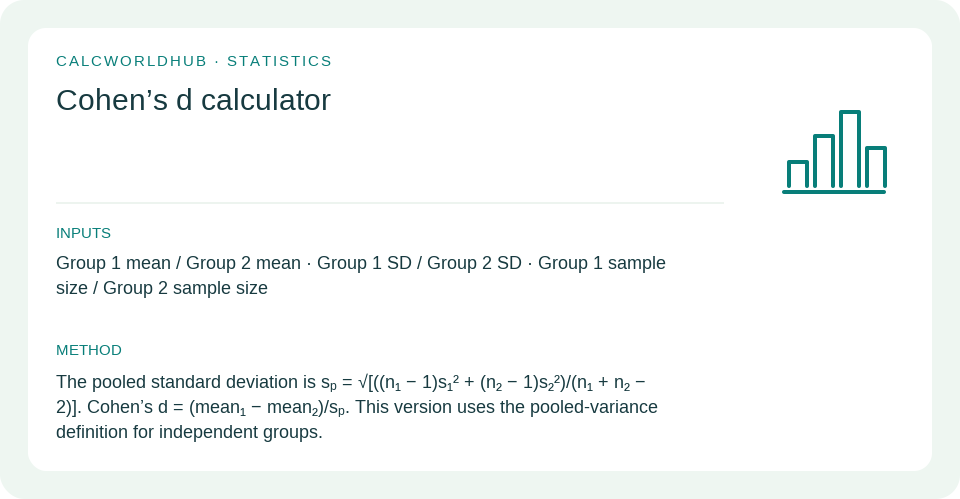
- Enter Group 1 mean / Group 2 mean, Group 1 SD / Group 2 SD, Group 1 sample size / Group 2 sample size. Match the units shown beside each field and review the result together with the assumptions below.
- Read the worked example below to check the expected input format and result.
- Compare another scenario by changing one input at a time. Use Reset to return to the starting values.
Put a difference in means on a standard-deviation scale
Cohen’s d expresses the difference between two independent group means in units of pooled within-group spread. It keeps the direction of the comparison: swapping Group 1 and Group 2 changes the sign.
Inputs for this calculation
- Group 1 mean / Group 2 mean: Use the sample averages for the same outcome and measurement scale.
- Group 1 SD / Group 2 SD: Use each group’s sample standard deviation; both must use the same units as the means.
- Group 1 sample size / Group 2 sample size: Enter the number of independent observations behind each group summary.
Formula and method
The pooled standard deviation is sₚ = √[((n₁ − 1)s₁² + (n₂ − 1)s₂²)/(n₁ + n₂ − 2)]. Cohen’s d = (mean₁ − mean₂)/sₚ. This version uses the pooled-variance definition for independent groups.
Worked example
For means 15 and 12, standard deviations 5 and 4, and sample sizes 40 and 30, sₚ = √[(39×25 + 29×16)/68] ≈ 4.600. The mean difference is 3, so d = 3/4.600 ≈ 0.652.
Reading the result
Here the positive sign says Group 1’s mean is higher, by about 0.652 pooled standard deviations. Magnitude labels such as small or large are only rough conventions; practical importance depends on the outcome and setting.
Assumptions and limits
The pooled version assumes independent groups and is most interpretable when a common within-group spread is reasonable. It is not the standardized mean difference for paired observations.
Frequently asked questions
Does a positive Cohen’s d mean the treatment worked?
No. It only gives the direction and standardized size of the observed mean difference. Study design, uncertainty, and confounding determine what can be concluded.
Are small, medium, and large cutoffs universal?
No. Conventional cutoffs are context-dependent guides, not decision thresholds for every field.
How do I use the Cohen’s d calculator?
Enter Group 1 mean / Group 2 mean, Group 1 SD / Group 2 SD, Group 1 sample size / Group 2 sample size. Match the units shown beside each field and review the result together with the assumptions below.
What is a worked example of Cohen’s d?
For means 15 and 12, standard deviations 5 and 4, and sample sizes 40 and 30, sₚ = √[(39×25 + 29×16)/68] ≈ 4.600. The mean difference is 3, so d = 3/4.600 ≈ 0.652.
What does the Cohen’s d calculator calculate?
Free Cohen’s d calculator. Standardize the difference between two group means using pooled within-group spread.