How to use this calculator
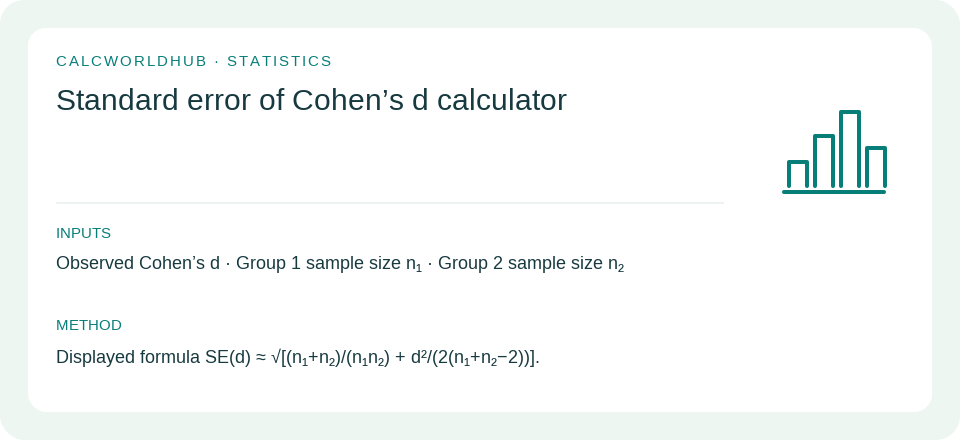
Approximate the sampling standard error of a pooled-SD Cohen’s d from the effect size and two independent sample sizes.
- Enter Observed Cohen’s d, Group 1 sample size n₁, Group 2 sample size n₂. Match the units shown beside each field and review the result together with the assumptions below.
- Read the worked example below to check the expected input format and result.
- Compare another scenario by changing one input at a time. Use Reset to return to the starting values.
How this measure is calculated
The first term reflects finite sample sizes; the second term incorporates the observed standardized effect. This is a commonly used large-sample approximation.
Inputs and units
d— Observed Cohen’s d- Enter the signed pooled-SD standardized mean difference.
n1— Group 1 sample size n₁- Number of independent observations in group 1.
n2— Group 2 sample size n₂- Number of independent observations in group 2.
Formula
SE(d) ≈ √[(n₁+n₂)/(n₁n₂) + d²/(2(n₁+n₂−2))].
Worked example
For d=0.5 with n₁=20 and n₂=25, the approximation gives SE≈√(45/500+0.25/(2×43))=0.3048.
Assumptions and limits
Assumes independent groups and a pooled-variance standardized mean difference. Small samples, unequal variances, paired designs, and bias-corrected Hedges’ g require different variance formulas.
Frequently asked questions
Is this the standard error of the raw mean difference?
No. It is the approximate standard error of standardized Cohen’s d, which is dimensionless.
Can I use it for Hedges’ g?
Do not assume so without checking a small-sample variance formula for the bias-corrected estimator.
Does the result include uncertainty in the standard deviations?
The formula approximates sampling variance under its pooled-variance assumptions; it is not a robust or exact interval method for every design.
How do I use the Standard error of Cohen’s d calculator?
Enter Observed Cohen’s d, Group 1 sample size n₁, Group 2 sample size n₂. Match the units shown beside each field and review the result together with the assumptions below.
What is a worked example of Standard error of Cohen’s d?
For d=0.5 with n₁=20 and n₂=25, the approximation gives SE≈√(45/500+0.25/(2×43))=0.3048.
Read our calculation methodology.