Hourly pay and overtime calculator
This arithmetic uses the overtime hours and multiplier you enter. It does not determine whether a worker is legally entitled to overtime.
Calculator
How to use this calculator
Estimate gross pay and after-deduction pay from entered hourly rate, hours, overtime multiplier, and deduction percentage.
- Enter Hourly rate ($), Regular hours, Overtime hours, Overtime multiplier, then complete the remaining labeled fields. Match the units shown beside each field and review the result together with the assumptions below.
- Read the worked example below to check the expected input format and result.
- Compare another scenario by changing one input at a time. Use Reset to return to the starting values.
Hourly pay and overtime calculator
This arithmetic uses the overtime hours and multiplier you enter. It does not determine whether a worker is legally entitled to overtime.
What it measures
Regular pay is hourly rate times regular hours; overtime pay uses the entered multiplier. The net estimate subtracts the entered percentage from gross pay.
Inputs and units
- Hourly rate ($): Hourly rate in dollars for regular time.
- Regular hours: Regular paid hours in the period.
- Overtime hours: Overtime hours as determined by your applicable rules.
- Overtime multiplier: Multiplier applied to the hourly rate for those hours.
- Estimated deductions (%): Estimated deductions as a percentage of gross pay; this is not tax withholding advice.
Formula and method
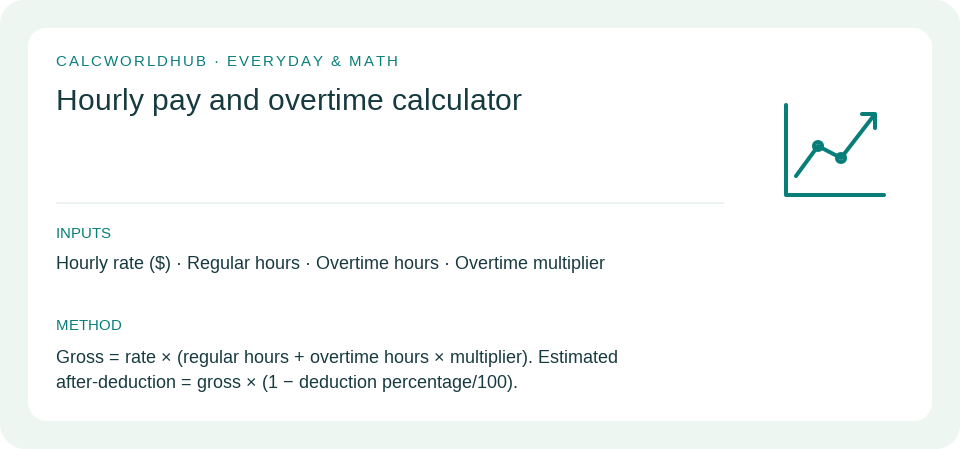
Gross = rate × (regular hours + overtime hours × multiplier). Estimated after-deduction = gross × (1 − deduction percentage/100).
Worked example
At $20/hour for 40 regular hours and 5 overtime hours at 1.5×, gross = $20×(40+7.5) = $950. With 0% entered deductions, the estimate remains $950.
Interpreting the result
The net line is only an assumed percentage reduction. Actual take-home pay depends on tax withholding, benefits, deductions, and payroll rules.
Assumptions and limits
Overtime laws differ by jurisdiction, coverage, exemption, workweek, regular-rate definition, and agreement. The U.S. federal rule for covered nonexempt employees generally uses at least 1.5 times regular rate after 40 hours; verify the rules that apply.
Sources and method
- States the federal FLSA rule for covered, nonexempt employees while noting that legal coverage and pay calculations depend on employment circumstances. U.S. Department of Labor: Overtime
Frequently asked questions
Does this decide which hours are overtime?
No. Enter hours identified under the rules or agreement that apply to the worker.
Is “after entered deductions” actual take-home pay?
No. It applies only the percentage entered and omits payroll-specific taxes and deductions.
How do I use the Hourly pay and overtime calculator?
Enter Hourly rate ($), Regular hours, Overtime hours, Overtime multiplier, then complete the remaining labeled fields. Match the units shown beside each field and review the result together with the assumptions below.
What is a worked example of Hourly pay and overtime?
At $20/hour for 40 regular hours and 5 overtime hours at 1.5×, gross = $20×(40+7.5) = $950. With 0% entered deductions, the estimate remains $950.
What does the Hourly pay and overtime calculator calculate?
Estimate gross pay and after-deduction pay from entered hourly rate, hours, overtime multiplier, and deduction percentage.
See the calculation methodology.
Good calculators show their work.
CalcWorldHub is built around clear inputs and visible assumptions. Results are estimates for planning; check official sources or your provider’s terms when exact figures matter.