How to use this calculator
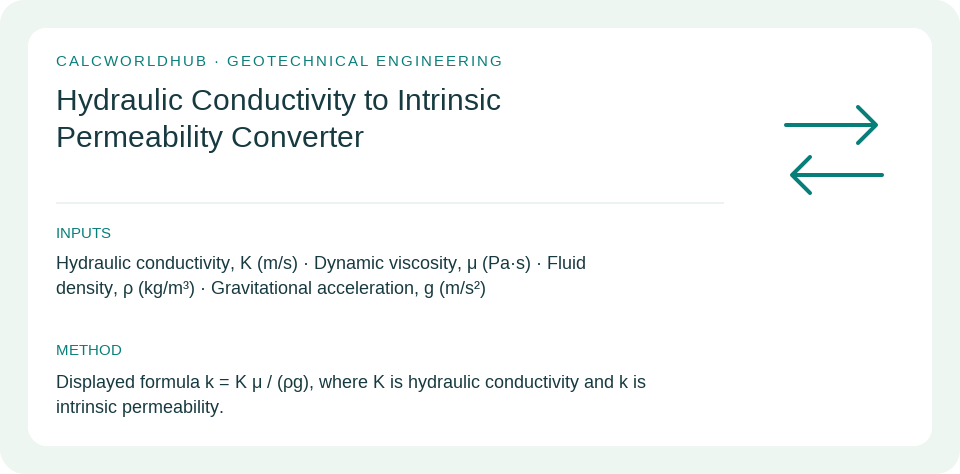
Convert hydraulic conductivity to intrinsic permeability using the flowing fluid’s density and dynamic viscosity.
- Enter Hydraulic conductivity, K (m/s), Dynamic viscosity, μ (Pa·s), Fluid density, ρ (kg/m³), Gravitational acceleration, g (m/s²). Match the units shown beside each field and review the result together with the assumptions below.
- Read the worked example below to check the expected input format and result.
- Compare another scenario by changing one input at a time. Use Reset to return to the starting values.
How this calculation works
Hydraulic conductivity depends on both the pore structure and the fluid, while intrinsic permeability describes the porous material itself. Converting between them requires the fluid density, dynamic viscosity, and gravitational acceleration used for the conductivity measurement.
Inputs and units
hydraulicConductivityMs— Hydraulic conductivity, K (m/s)- Hydraulic conductivity for the porous material and fluid conditions entered below.
viscosityPas— Dynamic viscosity, μ (Pa·s)- Dynamic viscosity of the fluid at the test temperature.
densityKgM3— Fluid density, ρ (kg/m³)- Fluid density at the temperature used for hydraulic conductivity.
gravityMs2— Gravitational acceleration, g (m/s²)- Gravitational acceleration used in the conductivity-to-permeability relation.
Formula
k = K μ / (ρg), where K is hydraulic conductivity and k is intrinsic permeability.
Method
Enter hydraulic conductivity in metres per second, dynamic viscosity in pascal-seconds, fluid density in kilograms per cubic metre, and gravitational acceleration in metres per second squared. The result is reported in square metres and darcies.
Worked example
For K = 1.00 × 10⁻⁵ m/s in water at 20 °C (μ = 1.002 × 10⁻³ Pa·s, ρ = 998.2 kg/m³), k = 1.024 × 10⁻¹² m² = 1.037 D.
Assumptions and limits
The relationship assumes saturated single-phase Darcy flow and consistent fluid properties for the conductivity value. Intrinsic permeability is a material property; hydraulic conductivity changes when the fluid or its temperature changes.
Frequently asked questions
Why does the conversion need fluid properties?
Hydraulic conductivity includes fluid density and viscosity, while intrinsic permeability is intended to describe the pore structure independently of the fluid.
What is a darcy?
One darcy is 9.869233 × 10⁻¹³ square metres of intrinsic permeability.
Can I compare conductivity values measured at different temperatures?
Convert them with the corresponding fluid density and viscosity, or first correct the conductivity to a common fluid temperature.
How do I use the Hydraulic Conductivity to Intrinsic Permeability Converter?
Enter Hydraulic conductivity, K (m/s), Dynamic viscosity, μ (Pa·s), Fluid density, ρ (kg/m³), Gravitational acceleration, g (m/s²). Match the units shown beside each field and review the result together with the assumptions below.
What is a worked example of Hydraulic Conductivity to Intrinsic Permeability Converter?
For K = 1.00 × 10⁻⁵ m/s in water at 20 °C (μ = 1.002 × 10⁻³ Pa·s, ρ = 998.2 kg/m³), k = 1.024 × 10⁻¹² m² = 1.037 D.
Reference: U.S. Geological Survey hydraulic-conductivity to intrinsic-permeability relation. See our calculation methodology.