How to use this calculator
Calculate a dimensionless cavitation number from absolute pressure, vapor pressure, density, and flow speed.
- Enter Local absolute static pressure (kPa), Liquid vapor pressure at operating temperature (kPa), Liquid density (kg/m³), Reference flow velocity (m/s). Match the units shown beside each field and review the result together with the assumptions below.
- Read the worked example below to check the expected input format and result.
- Compare another scenario by changing one input at a time. Use Reset to return to the starting values.
How this calculation works
A cavitation number compares the pressure available above a liquid’s vapor pressure with the flow’s dynamic pressure. It is useful for describing a reference operating point in valves, nozzles, pumps, and hydraulic structures, provided pressure and velocity are defined at the same location.
Inputs and units
pressureKPa— Local absolute static pressure (kPa)- Use absolute pressure at the selected flow reference section; convert gauge pressure by adding local atmospheric pressure.
vaporKPa— Liquid vapor pressure at operating temperature (kPa)- Use saturation vapor pressure for the liquid and temperature at the same reference conditions.
density— Liquid density (kg/m³)- Use density at the operating temperature and composition.
velocity— Reference flow velocity (m/s)- Use velocity at the same reference section as the local static pressure.
Formula
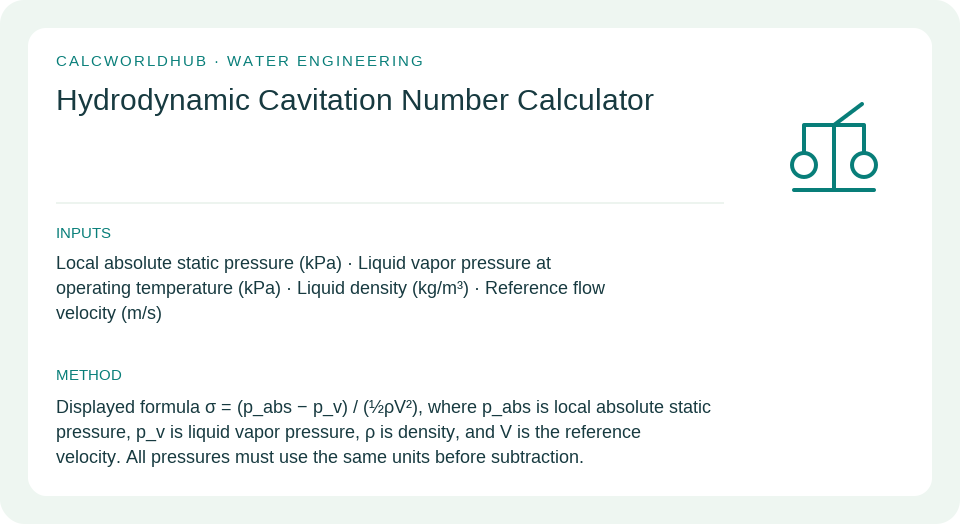
σ = (p_abs − p_v) / (½ρV²), where p_abs is local absolute static pressure, p_v is liquid vapor pressure, ρ is density, and V is the reference velocity. All pressures must use the same units before subtraction.
Method
The calculator converts both entered pressures from kPa to Pa, computes dynamic pressure as one-half density times velocity squared, then divides the pressure difference by that dynamic pressure.
Worked example
At 250 kPa absolute pressure, 2.34 kPa vapor pressure, density 998.2 kg/m³, and 4 m/s reference velocity, dynamic pressure is 7.9856 kPa and σ = (250−2.34)/7.9856 ≈ 31.013.
Assumptions and limits
Cavitation number is a comparison parameter, not a universal pass/fail threshold. Cavitation inception depends on geometry, surface condition, nuclei, turbulence, and how the reference pressure and velocity are chosen. Use absolute rather than gauge pressure, and do not interpret this result alone as a safety or equipment rating.
Frequently asked questions
Is a lower cavitation number always unsafe?
It often indicates less pressure margin relative to dynamic pressure, but inception thresholds depend on equipment geometry and test conditions; there is no universal cutoff.
Can I enter gauge pressure?
Convert it to absolute pressure first by adding the local atmospheric pressure. Vapor pressure is also absolute.
Where should pressure and velocity be measured?
Use a documented reference section and define both quantities at that same location; a different reference section can produce a different cavitation number.
How do I use the Hydrodynamic Cavitation Number Calculator?
Enter Local absolute static pressure (kPa), Liquid vapor pressure at operating temperature (kPa), Liquid density (kg/m³), Reference flow velocity (m/s). Match the units shown beside each field and review the result together with the assumptions below.
What is a worked example of Hydrodynamic Cavitation Number?
At 250 kPa absolute pressure, 2.34 kPa vapor pressure, density 998.2 kg/m³, and 4 m/s reference velocity, dynamic pressure is 7.9856 kPa and σ = (250−2.34)/7.9856 ≈ 31.013.
Reference: U.S. Army Corps of Engineers Engineering Manual on hydraulic design, including cavitation index. See our calculation methodology.