How to use this calculator
Compare modeled operating flow and head for identical pumps in series or parallel against a quadratic system curve.
- Complete the labeled inputs for Identical pumps series parallel operating comparison. Use the units requested by each field, then read the displayed result alongside the method and limits below.
- Read the worked example below to check the expected input format and result.
- Compare another scenario by changing one input at a time. Use Reset to return to the starting values.
The system curve sets the operating point
Formula and method
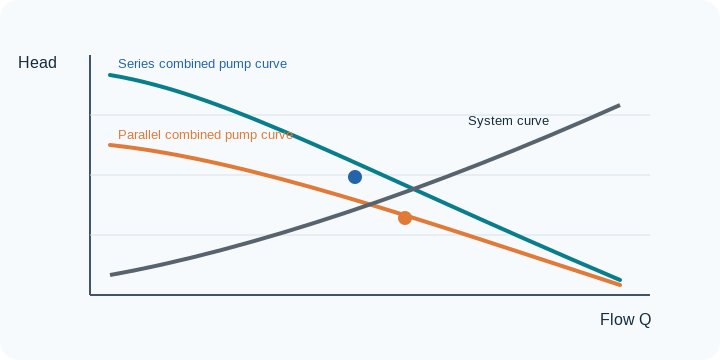
Each pump is modeled as H=H₀−aQ² and the system as H=Hₛ+KQ². In parallel, each pump carries Qtotal/N; in series, each pump carries total flow and heads add. The calculator solves the idealized curve intersection for the selected connection.
Worked example
With H₀=40 m, a=300, Hₛ=10 m, K=150, and two pumps, parallel operation gives total flow Q≈0.365 m³/s at a 30 m system head. In series, Q≈0.305 m³/s; the runtime reports 12 m head per pump, or 24 m combined, where the system curve meets the combined pump curve.
Interpreting the result
The comparison is specific to both pump and system curves. A connection that looks favorable at one point can behave differently when static head or curve shape changes.
Assumptions and limits
Real pump curves are not exact parabolas and may include minimum flow, efficiency, power, cavitation, and operating-range limits. Use manufacturer curves and the connected system’s measured characteristics for selection.
Sources and method notes
Frequently asked questions
Do parallel pumps double the delivered flow?
Not generally. The higher combined flow also raises system losses, so the operating flow is where the combined pump curve meets the system curve.
Can unequal pumps use the equal-flow split shown here?
No. Unequal pump curves need a common-head balance to determine each pump’s flow.
Does a valid operating point confirm adequate NPSH?
No. Check suction conditions and the manufacturer’s required NPSH separately at the operating flow.
How do I use the Identical pumps series parallel operating comparison calculator?
Complete the labeled inputs for Identical pumps series parallel operating comparison. Use the units requested by each field, then read the displayed result alongside the method and limits below.
What is a worked example of Identical pumps series parallel operating comparison?
With H₀=40 m, a=300, Hₛ=10 m, K=150, and two pumps, parallel operation gives total flow Q≈0.365 m³/s at a 30 m system head. In series, Q≈0.305 m³/s; the runtime reports 12 m head per pump, or 24 m combined, where the system curve meets the combined pump curve.
Read our calculation methodology.