How to use this calculator
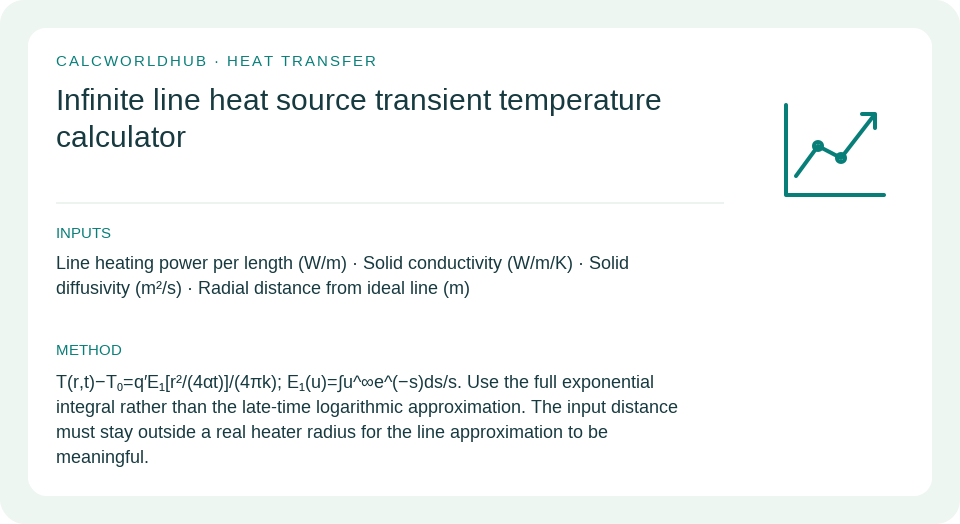
Predict radial thermal response around a continuously heated long line, such as an idealized borehole or embedded wire.
- Enter Line heating power per length (W/m), Solid conductivity (W/m/K), Solid diffusivity (m²/s), Radial distance from ideal line (m), then complete the remaining labeled fields. Match the units shown beside each field and review the result together with the assumptions below.
- Read the worked example below to check the expected input format and result.
- Compare another scenario by changing one input at a time. Use Reset to return to the starting values.
Infinite line heat source transient temperature explained
Use Line heating power per length (W/m) with Solid conductivity (W/m/K) to reproduce the sample calculation, then review the stated limits before carrying the result into another scenario.
A numerical walkthrough
Line heating power per length (W/m) = 20; Solid conductivity (W/m/K) = 2; Solid diffusivity (m²/s) = 8.00000000e-07; Radial distance from ideal line (m) = 0.02; Elapsed heating time (s) = 3600; Uniform starting temperature (°C) = 15.
- Temperature at radial distance: 17.242161 °C
- Temperature rise from line source: 2.242161 K
- Dimensionless inverse diffusion time: 0.034722
A 20 W/m line heater runs for one hour in material with k=2 W/m/K and alpha=8e−7 m²/s. At radius 0.02 m, the exact line-source response rises 2.24216 K from 15 °C, giving 17.2422 °C.
The model behind the numbers
T(r,t)−T₀=q′E₁[r²/(4αt)]/(4πk); E₁(u)=∫u^∞e^(−s)ds/s.
Use the full exponential integral rather than the late-time logarithmic approximation. The input distance must stay outside a real heater radius for the line approximation to be meaningful.
What to enter
qp— Line heating power per length (W/m)- Line heating power per length (W/m). Enter the value for this state; the units shown are used without an unstated conversion.
k— Solid conductivity (W/m/K)- Solid conductivity (W/m/K). Enter the value for this state; the units shown are used without an unstated conversion.
alpha— Solid diffusivity (m²/s)- Solid diffusivity (m²/s). Enter the value for this state; the units shown are used without an unstated conversion.
r— Radial distance from ideal line (m)- Radial distance from ideal line (m). Enter the value for this state; the units shown are used without an unstated conversion.
t— Elapsed heating time (s)- Elapsed heating time (s). Enter the value for this state; the units shown are used without an unstated conversion.
T0— Uniform starting temperature (°C)- Uniform starting temperature (°C). Enter the value for this state; the units shown are used without an unstated conversion.
Interpreting the result
Infinite homogeneous medium, negligible source radius and heat capacity, constant line power and properties. No fluid advection, end effects or contact resistance.
Reading the outputs
Local temperature and rise use °C and K; the inverse diffusion-time group is dimensionless.
Frequently asked questions
Why is zero radius rejected?
An ideal mathematical line has an unbounded temperature at its own axis.
Can this predict a real borehole wall at very early time?
Finite borehole capacity and resistance dominate there; the line model needs a suitable later-time and distance range.
Does temperature eventually reach steady state?
Not in a truly infinite two-dimensional line-source domain under persistent heating.
How do I use the Infinite line heat source transient temperature calculator?
Enter Line heating power per length (W/m), Solid conductivity (W/m/K), Solid diffusivity (m²/s), Radial distance from ideal line (m), then complete the remaining labeled fields. Match the units shown beside each field and review the result together with the assumptions below.
What is a worked example of Infinite line heat source transient temperature?
Line heating power per length (W/m) = 20; Solid conductivity (W/m/K) = 2; Solid diffusivity (m²/s) = 8.00000000e-07; Radial distance from ideal line (m) = 0.02; Elapsed heating time (s) = 3600; Uniform starting temperature (°C) = 15. Temperature at radial distance: 17.242161 °C Temperature rise from line source: 2.242161 K Dimensionless inverse diffusion time: 0.034722 A 20 W/m line heater runs for one hour in material with k=2 W/m/K and alpha=8e−7 m²/s. At radius 0.02 m, the exact line-source response rises 2.24216 K from 15 °C, giving 17.2422 °C.
Read our calculation methodology.