How to use this calculator
Follow spreading and peak-temperature decay after a finite-size instantaneous energy deposition in an unbounded solid.
- Enter Instantaneously deposited total energy (J), Volumetric heat capacity (J/m³/K), Initial Gaussian standard deviation per axis (m), Thermal diffusivity (m²/s), then complete the remaining labeled fields. Match the units shown beside each field and review the result together with the assumptions below.
- Read the worked example below to check the expected input format and result.
- Compare another scenario by changing one input at a time. Use Reset to return to the starting values.
Instantaneous Gaussian energy hotspot diffusion explained
An initially Gaussian heat deposit spreads as thermal diffusivity increases its variance with time. The calculator reports the resulting radial temperature rise after energy is conserved across the three-dimensional Gaussian profile.
Inputs, symbols, and units
E— Instantaneously deposited total energy (J)- Instantaneously deposited total energy (J). Enter the value for this state; the units shown are used without an unstated conversion.
rhoc— Volumetric heat capacity (J/m³/K)- Volumetric heat capacity (J/m³/K). Enter the value for this state; the units shown are used without an unstated conversion.
s— Initial Gaussian standard deviation per axis (m)- Initial Gaussian standard deviation per axis (m). Enter the value for this state; the units shown are used without an unstated conversion.
alpha— Thermal diffusivity (m²/s)- Thermal diffusivity (m²/s). Enter the value for this state; the units shown are used without an unstated conversion.
t— Time after energy deposition (s)- Time after energy deposition (s). Enter the value for this state; the units shown are used without an unstated conversion.
r— Distance from hotspot center (m)- Distance from hotspot center (m). Enter the value for this state; the units shown are used without an unstated conversion.
T0— Uniform background temperature (°C)- Uniform background temperature (°C). Enter the value for this state; the units shown are used without an unstated conversion.
Formula and method
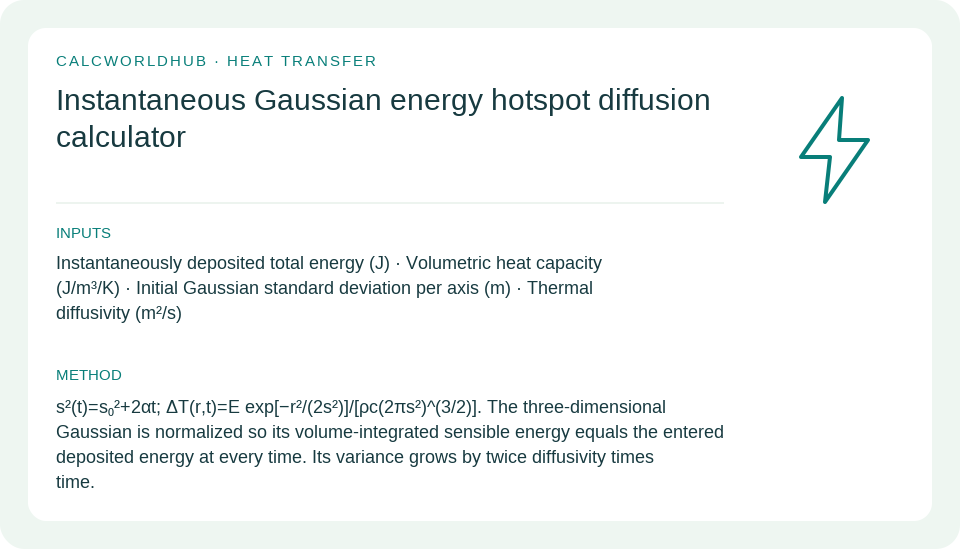
s²(t)=s₀²+2αt; ΔT(r,t)=E exp[−r²/(2s²)]/[ρc(2πs²)^(3/2)].
The three-dimensional Gaussian is normalized so its volume-integrated sensible energy equals the entered deposited energy at every time. Its variance grows by twice diffusivity times time.
A worked scenario
Instantaneously deposited total energy (J) = 100; Volumetric heat capacity (J/m³/K) = 2000000; Initial Gaussian standard deviation per axis (m) = 0.005; Thermal diffusivity (m²/s) = 0.000001; Time after energy deposition (s) = 10; Distance from hotspot center (m) = 0.005; Uniform background temperature (°C) = 20.
- Temperature at selected radius: 27.966069 °C
- Center temperature rise: 10.516747 K
- Current Gaussian standard deviation per axis: 0.006708 m
Depositing 100 J in a 5 mm Gaussian hotspot within material of volumetric heat capacity 2e6 J/m³/K and alpha=1e−6 m²/s gives a 10.5167 K center rise after 10 s. At radius 5 mm the local temperature is 27.9661 °C above a 20 °C background.
Assumptions and edge cases
Infinite isotropic solid, constant properties, no phase transition, subsequent source or boundary losses. Energy is initially Gaussian in all three dimensions.
Reading the outputs
Local temperature is °C; center rise is K; standard deviation describes one Cartesian axis in m.
Frequently asked questions
Is s the hotspot diameter?
No. It is the standard deviation in each axis; most energy extends over several such lengths.
Why is the center rise finite at t=0?
The initial energy is distributed over a finite Gaussian width rather than concentrated at a singular point.
Is total energy lost as the peak falls?
No. It spreads over a larger volume; no energy exits the infinite domain in this model.
How do I use the Instantaneous Gaussian energy hotspot diffusion calculator?
Enter Instantaneously deposited total energy (J), Volumetric heat capacity (J/m³/K), Initial Gaussian standard deviation per axis (m), Thermal diffusivity (m²/s), then complete the remaining labeled fields. Match the units shown beside each field and review the result together with the assumptions below.
What is a worked example of Instantaneous Gaussian energy hotspot diffusion?
Instantaneously deposited total energy (J) = 100; Volumetric heat capacity (J/m³/K) = 2000000; Initial Gaussian standard deviation per axis (m) = 0.005; Thermal diffusivity (m²/s) = 0.000001; Time after energy deposition (s) = 10; Distance from hotspot center (m) = 0.005; Uniform background temperature (°C) = 20. Temperature at selected radius: 27.966069 °C Center temperature rise: 10.516747 K Current Gaussian standard deviation per axis: 0.006708 m Depositing 100 J in a 5 mm Gaussian hotspot within material of volumetric heat capacity 2e6 J/m³/K and alpha=1e−6 m²/s gives a 10.5167 K center rise after 10 s.
Read our calculation methodology.