How to use this calculator
Generate Lagrange FIR coefficients for a fractional delay from interpolation order and sample delay.
- Enter Interpolation order, Desired delay (samples). Match the units shown beside each field and review the result together with the assumptions below.
- Read the worked example below to check the expected input format and result.
- Compare another scenario by changing one input at a time. Use Reset to return to the starting values.
Build a Lagrange FIR approximation for a fractional-sample delay
A Lagrange fractional-delay filter interpolates a sequence at a noninteger sample position using a finite polynomial. The calculator returns the taps and simple coefficient checks for the chosen order and delay.
Inputs and units
- Interpolation order: Polynomial order N; the FIR has N+1 taps.
- Desired delay (samples): Fractional delay D, between zero and the interpolation order.
Formula and method
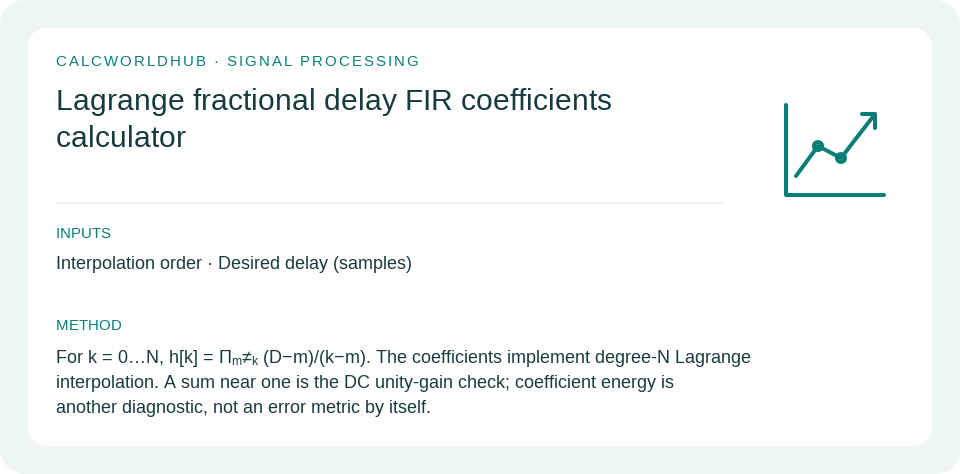
For k = 0…N, h[k] = Πₘ≠ₖ (D−m)/(k−m). The coefficients implement degree-N Lagrange interpolation. A sum near one is the DC unity-gain check; coefficient energy is another diagnostic, not an error metric by itself.
Worked example
For order N=3 and delay D=1.4 samples, the taps are approximately [−0.064, 0.672, 0.448, −0.056]. They sum to 1 and their squared energy is 0.65952.
Interpreting the result
The filter approximates a delay of 1.4 samples for signals in its intended frequency range. Negative taps are expected for some fractional delays and do not mean the coefficients are invalid.
Assumptions and limits
This is a finite-order approximation, not an ideal broadband delay. Accuracy depends on frequency and order; it does not change the sample rate or guarantee a particular passband or stopband specification.
Method references
Frequently asked questions
Why does the coefficient sum stay near one?
The interpolation polynomial reproduces a constant sequence, so its taps sum to unity apart from floating-point roundoff.
How do I use the Lagrange fractional delay FIR coefficients calculator?
Enter Interpolation order, Desired delay (samples). Match the units shown beside each field and review the result together with the assumptions below.
What is a worked example of Lagrange fractional delay FIR coefficients?
For order N=3 and delay D=1.4 samples, the taps are approximately [−0.064, 0.672, 0.448, −0.056]. They sum to 1 and their squared energy is 0.65952.
What does the Lagrange fractional delay FIR coefficients calculator calculate?
Generate Lagrange FIR coefficients for a fractional delay from interpolation order and sample delay.
What assumptions apply to Lagrange fractional delay FIR coefficients?
This is a finite-order approximation, not an ideal broadband delay. Accuracy depends on frequency and order; it does not change the sample rate or guarantee a particular passband or stopband specification.