How to use this calculator
Inspect how an entered FIR delays a narrowband envelope at a chosen frequency.
- Enter FIR coefficients, Sampling frequency (Hz), Inspection frequency (Hz). Match the units shown beside each field and review the result together with the assumptions below.
- Read the worked example below to check the expected input format and result.
- Compare another scenario by changing one input at a time. Use Reset to return to the starting values.
Arbitrary FIR group delay at a frequency explained
Use FIR coefficients with Sampling frequency (Hz) to reproduce the sample calculation, then review the stated limits before carrying the result into another scenario.
A numerical walkthrough
FIR coefficients = [0.2, 0.5, 0.2]; Sampling frequency (Hz) = 1000; Inspection frequency (Hz) = 100.
- Group delay: 0.001 s
- Group delay in samples: 1 samples
- Response magnitude: 0.823607 ratio
- Principal response phase: -36 deg
A symmetric three-tap filter has a one-sample delay where its response is nonzero; at a 1 kHz clock this is one millisecond.
The model behind the numbers
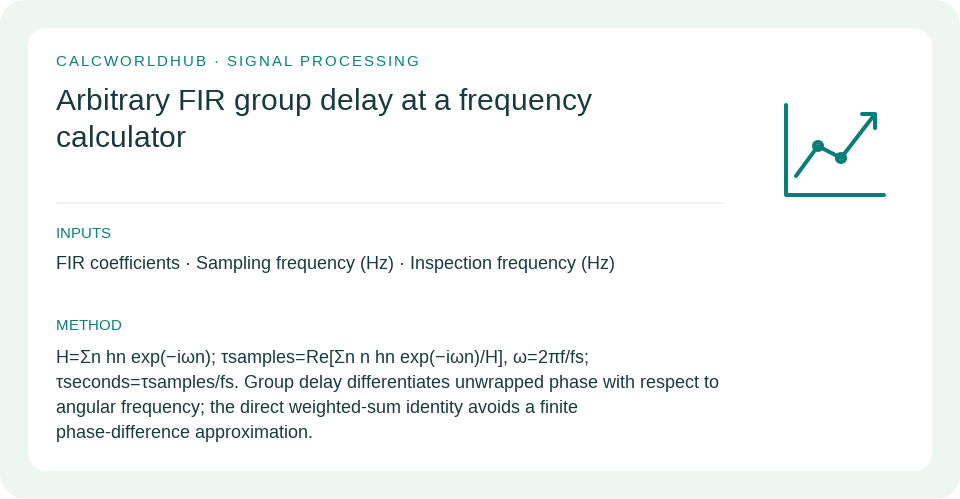
H=Σn hn exp(−iωn); τsamples=Re[Σn n hn exp(−iωn)/H], ω=2πf/fs; τseconds=τsamples/fs.
Group delay differentiates unwrapped phase with respect to angular frequency; the direct weighted-sum identity avoids a finite phase-difference approximation.
What to enter
taps— FIR coefficients- Real coefficients ordered from zero delay onward. Use comma-separated values in the stated order.
fs— Sampling frequency (Hz)- Uniform samples per second; must be positive.
f— Inspection frequency (Hz)- Nonnegative frequency at or below Nyquist.
Interpreting the result
At response zeros group delay is undefined. Negative delay values near cancellation do not imply information travels backward in time.
Reading the outputs
Both seconds and samples are shown; principal phase is separately wrapped and is not the derivative itself.
Frequently asked questions
Can FIR group delay be negative?
Yes, locally for some nonsymmetric responses; inspect attenuation and pulse reshaping too.
Why does a symmetric FIR often have constant delay?
Its linear phase slope is fixed between response zeros.
Is phase delay the same quantity?
No. Phase delay divides phase by frequency; group delay differentiates phase.
How do I use the Arbitrary FIR group delay at a frequency calculator?
Enter FIR coefficients, Sampling frequency (Hz), Inspection frequency (Hz). Match the units shown beside each field and review the result together with the assumptions below.
What is a worked example of Arbitrary FIR group delay at a frequency?
FIR coefficients = [0.2, 0.5, 0.2]; Sampling frequency (Hz) = 1000; Inspection frequency (Hz) = 100. Group delay: 0.001 s Group delay in samples: 1 samples Response magnitude: 0.823607 ratio Principal response phase: -36 deg A symmetric three-tap filter has a one-sample delay where its response is nonzero; at a 1 kHz clock this is one millisecond.
Background or definition reference: SciPy digital filter group delay.
Read our calculation methodology.