How to use this calculator
Apply actual FIR or IIR coefficients to a finite measurement record and inspect every output sample.
- Enter Uniform samples (signal units), Numerator coefficients b, Denominator coefficients a. Match the units shown beside each field and review the result together with the assumptions below.
- Read the worked example below to check the expected input format and result.
- Compare another scenario by changing one input at a time. Use Reset to return to the starting values.
Causal FIR IIR sample filtering explained
Apply the supplied causal FIR/IIR coefficient recurrence to the finite record from a zero initial state.
How the calculation works
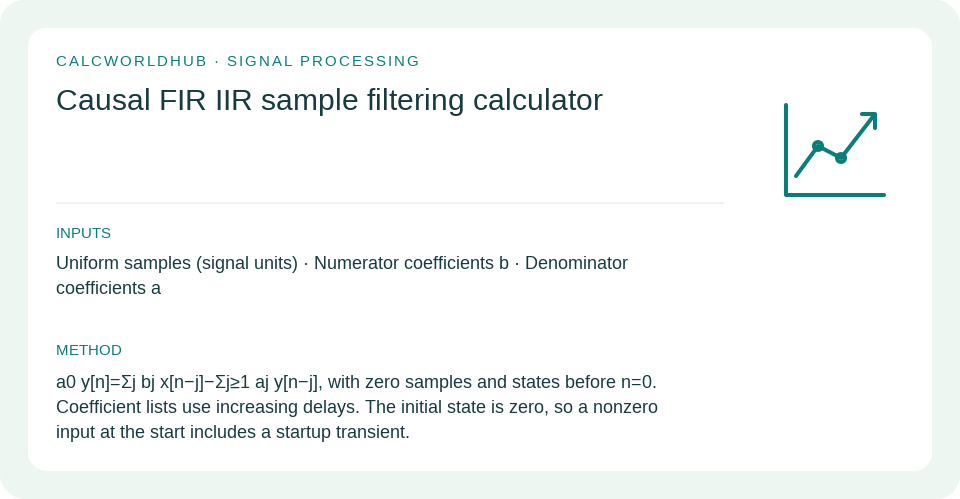
a0 y[n]=Σj bj x[n−j]−Σj≥1 aj y[n−j], with zero samples and states before n=0.
Coefficient lists use increasing delays. The initial state is zero, so a nonzero input at the start includes a startup transient.
Set up the calculation
x— Uniform samples (signal units)- Chronological real samples; use a comma-separated list in the same signal units. Use comma-separated values in the stated order.
b— Numerator coefficients b- Coefficients in ascending delay order b0,b1,… . Use comma-separated values in the stated order.
a— Denominator coefficients a- Coefficients a0,a1,… in ascending delay order; a0 cannot be zero. Use comma-separated values in the stated order.
Limits of this model
No stability guarantee, floating-point overflow is rejected, and long high-order direct forms can be numerically fragile.
Check this example
Uniform samples (signal units) = [1, 0, 0, 0, 1, 0, 0, 0]; Numerator coefficients b = [0.2, 0.2]; Denominator coefficients a = [1, -0.6].
- Last filtered value: 0.13013 signal units
- Output sample 0: 0.2 signal units
- Output sample 1: 0.32 signal units
- Output sample 2: 0.192 signal units
- Output sample 3: 0.1152 signal units
- Output sample 4: 0.26912 signal units
- Output sample 5: 0.361472 signal units
- Output sample 6: 0.216883 signal units
- Output sample 7: 0.13013 signal units
Two separated unit impulses enter a first-order low-pass recurrence with numerator [0.2,0.2] and denominator [1,−0.6].
The recurrence produces the final sample 0.13013 signal units; the second impulse contributes through both numerator taps and the recursive denominator.
Reading the outputs
All chronological outputs are returned; the first result repeats the final sample for endpoint comparisons.
Frequently asked questions
Must a0 equal one?
No. The recurrence divides every term by a0.
Can I enter a pure FIR?
Yes. Use denominator [1].
Are existing filter states supported?
No. This page assumes a zero state before the record.
How do I use the Causal FIR IIR sample filtering calculator?
Enter Uniform samples (signal units), Numerator coefficients b, Denominator coefficients a. Match the units shown beside each field and review the result together with the assumptions below.
What is a worked example of Causal FIR IIR sample filtering?
Uniform samples (signal units) = [1, 0, 0, 0, 1, 0, 0, 0]; Numerator coefficients b = [0.2, 0.2]; Denominator coefficients a = [1, -0.6]. Last filtered value: 0.13013 signal units Output sample 0: 0.2 signal units Output sample 1: 0.32 signal units Output sample 2: 0.192 signal units Output sample 3: 0.1152 signal units Output sample 4: 0.26912 signal units Output sample 5: 0.361472 signal units Output sample 6: 0.216883 signal units Output sample 7: 0.13013 signal units Two separated unit impulses enter a first-order low-pass recurrence with numerator [0.2,0.2] and denominator [1,−0.6].
Background or definition reference: SciPy causal difference-equation filtering.
Read our calculation methodology.