How to use this calculator
Train a short adaptive FIR from paired input and desired signals using normalized least-mean-square updates.
- Enter Uniform samples (signal units), Desired response, Adaptive filter length, Normalized adaptation step, then complete the remaining labeled fields. Match the units shown beside each field and review the result together with the assumptions below.
- Read the worked example below to check the expected input format and result.
- Compare another scenario by changing one input at a time. Use Reset to return to the starting values.
Normalized LMS adaptive FIR training explained
Normalized LMS updates FIR taps sample by sample, scaling each correction by the current input-vector power.
How the calculation works
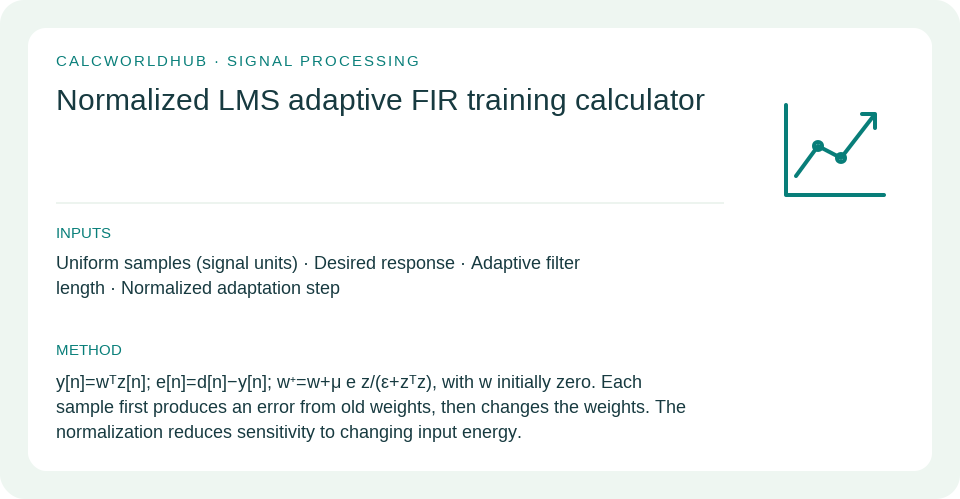
y[n]=wᵀz[n]; e[n]=d[n]−y[n]; w⁺=w+μ e z/(ε+zᵀz), with w initially zero.
Each sample first produces an error from old weights, then changes the weights. The normalization reduces sensitivity to changing input energy.
Set up the calculation
x— Uniform samples (signal units)- Chronological real samples; use a comma-separated list in the same signal units. Use comma-separated values in the stated order.
desired— Desired response- Target output samples sharing the input clock. Use comma-separated values in the stated order.
taps— Adaptive filter length- Zero-initialized FIR tap count. Enter a whole number.
mu— Normalized adaptation step- A step strictly between zero and two.
eps— Normalization floor- Positive input-power regularization in signal units squared.
Limits of this model
The usual normalized step range does not guarantee convergence for every finite record, model mismatch or nonstationary target.
Check this example
Uniform samples (signal units) = [1, 0, 1, -1, 0.5, 1, 0, -0.5]; Desired response = [0.5, 0.2, 0.5, -0.3, 0.05, 0.6, 0.2, -0.25]; Adaptive filter length = 2; Normalized adaptation step = 0.5; Normalization floor = 0.001.
- Training prediction error RMS: 0.220458 output units
- Final pre-update error: -0.029765 output units
- Final adaptive tap 0: 0.470116 output/input
- Final adaptive tap 1: 0.173356 output/input
An eight-sample training pair approximates a two-tap system; inspect both learned coefficients and the errors encountered during adaptation.
Reading the outputs
RMS summarizes pre-update training errors, not errors from replaying the final filter. Every final tap is shown.
Frequently asked questions
Why add a normalization floor?
It prevents excessive updates when input energy is nearly zero.
Is this an ordinary fixed least-squares solution?
No. The order of training samples affects sequential adaptive updates.
Can I estimate an echo path?
A short linear echo path is a suitable model, but real systems may require many more taps.
How do I use the Normalized LMS adaptive FIR training calculator?
Enter Uniform samples (signal units), Desired response, Adaptive filter length, Normalized adaptation step, then complete the remaining labeled fields. Match the units shown beside each field and review the result together with the assumptions below.
What is a worked example of Normalized LMS adaptive FIR training?
Uniform samples (signal units) = [1, 0, 1, -1, 0.5, 1, 0, -0.5]; Desired response = [0.5, 0.2, 0.5, -0.3, 0.05, 0.6, 0.2, -0.25]; Adaptive filter length = 2; Normalized adaptation step = 0.5; Normalization floor = 0.001. Training prediction error RMS: 0.220458 output units Final pre-update error: -0.029765 output units Final adaptive tap 0: 0.470116 output/input Final adaptive tap 1: 0.173356 output/input An eight-sample training pair approximates a two-tap system; inspect both learned coefficients and the errors encountered during adaptation.
Background or definition reference: MathWorks normalized LMS update convention.
Read our calculation methodology.