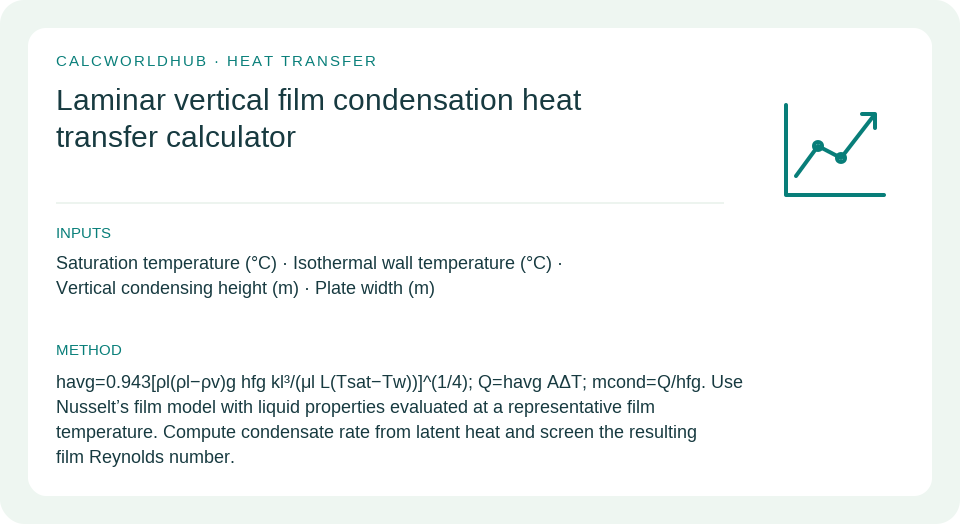
How to use this calculator
Estimate gravity-driven condensation on a cooled vertical plate when a continuous laminar liquid film controls heat transfer.
- Enter Saturation temperature (°C), Isothermal wall temperature (°C), Vertical condensing height (m), Plate width (m), then complete the remaining labeled fields. Match the units shown beside each field and review the result together with the assumptions below.
- Read the worked example below to check the expected input format and result.
- Compare another scenario by changing one input at a time. Use Reset to return to the starting values.
Laminar vertical film condensation heat transfer explained
Use Saturation temperature (°C) with Isothermal wall temperature (°C) to reproduce the sample calculation, then review the stated limits before carrying the result into another scenario.
A numerical walkthrough
Saturation temperature (°C) = 100; Isothermal wall temperature (°C) = 80; Vertical condensing height (m) = 0.5; Plate width (m) = 0.2; Condensate liquid density (kg/m³) = 965; Vapor density (kg/m³) = 0.6; Condensate conductivity (W/m/K) = 0.68; Condensate dynamic viscosity (Pa s) = 0.000315; Latent heat (J/kg) = 2257000.
- Average film-condensation coefficient: 6350.01756 W/m²/K
- Condensation heat rate: 12700.035119 W
- Condensate mass flow: 0.005627 kg/s
Saturated vapor at 100 °C condenses on a 0.5 m tall by 0.2 m wide wall held at 80 °C. The supplied properties give mean h=6,350.02 W/m²/K, a 12.7000 kW duty and 0.00562695 kg/s condensate.
The model behind the numbers
havg=0.943[ρl(ρl−ρv)g hfg kl³/(μl L(Tsat−Tw))]^(1/4); Q=havg AΔT; mcond=Q/hfg.
Use Nusselt’s film model with liquid properties evaluated at a representative film temperature. Compute condensate rate from latent heat and screen the resulting film Reynolds number.
What to enter
Tsat— Saturation temperature (°C)- Saturation temperature (°C). Enter the value for this state; the units shown are used without an unstated conversion.
Tw— Isothermal wall temperature (°C)- Isothermal wall temperature (°C). Enter the value for this state; the units shown are used without an unstated conversion.
L— Vertical condensing height (m)- Vertical condensing height (m). Enter the value for this state; the units shown are used without an unstated conversion.
W— Plate width (m)- Plate width (m). Enter the value for this state; the units shown are used without an unstated conversion.
rl— Condensate liquid density (kg/m³)- Condensate liquid density (kg/m³). Enter the value for this state; the units shown are used without an unstated conversion.
rv— Vapor density (kg/m³)- Vapor density (kg/m³). Enter the value for this state; the units shown are used without an unstated conversion.
kl— Condensate conductivity (W/m/K)- Condensate conductivity (W/m/K). Enter the value for this state; the units shown are used without an unstated conversion.
mu— Condensate dynamic viscosity (Pa s)- Condensate dynamic viscosity (Pa s). Enter the value for this state; the units shown are used without an unstated conversion.
latent— Latent heat (J/kg)- Latent heat (J/kg). Enter the value for this state; the units shown are used without an unstated conversion.
Interpreting the result
Pure saturated vapor, negligible vapor shear/noncondensable gas, laminar film and approximately isothermal plate. No condensate sensible-heat correction or dropwise condensation.
Reading the outputs
Returns average coefficient, latent heat rate and condensate mass flow.
Frequently asked questions
Can this model dropwise condensation?
No. Dropwise behavior has a different thermal resistance and may not persist.
Why can a noncondensable gas greatly reduce heat transfer?
Diffusion through the gas layer adds resistance absent from the pure-vapor film model.
Is the condensate rate a local value?
No. It is total liquid formed over the entered plate area.
How do I use the Laminar vertical film condensation heat transfer calculator?
Enter Saturation temperature (°C), Isothermal wall temperature (°C), Vertical condensing height (m), Plate width (m), then complete the remaining labeled fields. Match the units shown beside each field and review the result together with the assumptions below.
What is a worked example of Laminar vertical film condensation heat transfer?
Saturation temperature (°C) = 100; Isothermal wall temperature (°C) = 80; Vertical condensing height (m) = 0.5; Plate width (m) = 0.2; Condensate liquid density (kg/m³) = 965; Vapor density (kg/m³) = 0.6; Condensate conductivity (W/m/K) = 0.68; Condensate dynamic viscosity (Pa s) = 0.000315; Latent heat (J/kg) = 2257000. Average film-condensation coefficient: 6350.01756 W/m²/K Condensation heat rate: 12700.035119 W Condensate mass flow: 0.005627 kg/s Saturated vapor at 100 °C condenses on a 0.5 m tall by 0.2 m wide wall held at 80 °C. The supplied properties give mean h=6,350.02 W/m²/K, a 12.7000 kW duty and 0.00562695 kg/s condensate.
Background or definition reference: IIT NPTEL boiling and condensation teaching module.
Read our calculation methodology.