How to use this calculator
Estimate saturated nucleate pool-boiling heat flux for a specified liquid and surface pair using explicit empirical constants.
- Enter Wall superheat above saturation (K), Liquid dynamic viscosity (Pa s), Latent heat (J/kg), Liquid density (kg/m³), then complete the remaining labeled fields. Match the units shown beside each field and review the result together with the assumptions below.
- Read the worked example below to check the expected input format and result.
- Compare another scenario by changing one input at a time. Use Reset to return to the starting values.
Rohsenow nucleate pool boiling heat flux explained
Inputs, symbols, and units
dt— Wall superheat above saturation (K)- Wall superheat above saturation (K). Enter the value for this state; the units shown are used without an unstated conversion.
mu— Liquid dynamic viscosity (Pa s)- Liquid dynamic viscosity (Pa s). Enter the value for this state; the units shown are used without an unstated conversion.
latent— Latent heat (J/kg)- Latent heat (J/kg). Enter the value for this state; the units shown are used without an unstated conversion.
rl— Liquid density (kg/m³)- Liquid density (kg/m³). Enter the value for this state; the units shown are used without an unstated conversion.
rv— Vapor density (kg/m³)- Vapor density (kg/m³). Enter the value for this state; the units shown are used without an unstated conversion.
sig— Surface tension (N/m)- Surface tension (N/m). Enter the value for this state; the units shown are used without an unstated conversion.
cp— Liquid specific heat (J/kg/K)- Liquid specific heat (J/kg/K). Enter the value for this state; the units shown are used without an unstated conversion.
Pr— Liquid Prandtl number- Liquid Prandtl number. Enter the value for this state; the units shown are used without an unstated conversion.
Cs— Surface-fluid constant Csf- Surface-fluid constant Csf. Enter the value for this state; the units shown are used without an unstated conversion.
n— Fluid exponent n- Fluid exponent n. Enter the value for this state; the units shown are used without an unstated conversion.
A— Boiling surface area (m²)- Boiling surface area (m²). Enter the value for this state; the units shown are used without an unstated conversion.
Formula and method
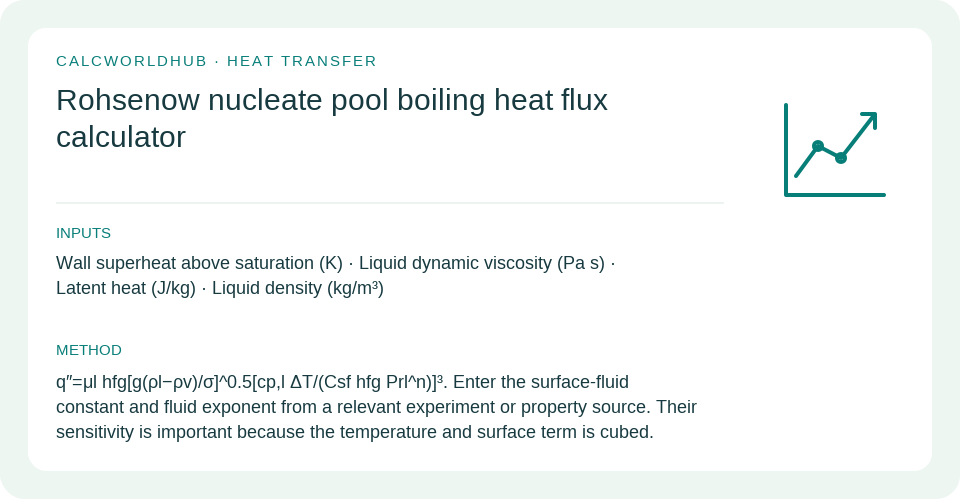
q″=μl hfg[g(ρl−ρv)/σ]^0.5[cp,l ΔT/(Csf hfg Prl^n)]³.
Enter the surface-fluid constant and fluid exponent from a relevant experiment or property source. Their sensitivity is important because the temperature and surface term is cubed.
A worked scenario
Wall superheat above saturation (K) = 10; Liquid dynamic viscosity (Pa s) = 0.000282; Latent heat (J/kg) = 2257000; Liquid density (kg/m³) = 958; Vapor density (kg/m³) = 0.6; Surface tension (N/m) = 0.059; Liquid specific heat (J/kg/K) = 4217; Liquid Prandtl number = 1.75; Surface-fluid constant Csf = 0.013; Fluid exponent n = 1; Boiling surface area (m²) = 0.01.
- Nucleate boiling heat flux: 140648.023592 W/m²
- Effective boiling coefficient: 14064.802359 W/m²/K
- Vapor generation from entered area: 0.000623 kg/s
At a 10 K wall superheat, the supplied water-like properties and Csf=0.013, n=1 predict nucleate heat flux 140,648 W/m². A 0.01 m² surface would generate 0.000623164 kg/s vapor under that regime; the result still needs a separate boiling-crisis check.
Assumptions and edge cases
Saturated nucleate pool boiling only. This correlation does not locate onset, transition or film boiling; independently check critical heat flux before treating an estimate as usable.
Reading the outputs
Flux is W/m², effective h is flux divided by superheat, and vapor rate assumes all predicted heat goes into latent evaporation.
Frequently asked questions
Can I use Csf=0.013 for every surface?
No. The constant is fluid, material and surface-condition dependent.
Does doubling superheat double heat flux?
Under this correlation it increases flux eightfold, as long as the nucleate regime still applies.
What protects against boiling crisis here?
Nothing automatically. Compare with a suitable critical-heat-flux model and equipment-specific limits.
How do I use the Rohsenow nucleate pool boiling heat flux calculator?
Enter Wall superheat above saturation (K), Liquid dynamic viscosity (Pa s), Latent heat (J/kg), Liquid density (kg/m³), then complete the remaining labeled fields. Match the units shown beside each field and review the result together with the assumptions below.
What is a worked example of Rohsenow nucleate pool boiling heat flux?
Wall superheat above saturation (K) = 10; Liquid dynamic viscosity (Pa s) = 0.000282; Latent heat (J/kg) = 2257000; Liquid density (kg/m³) = 958; Vapor density (kg/m³) = 0.6; Surface tension (N/m) = 0.059; Liquid specific heat (J/kg/K) = 4217; Liquid Prandtl number = 1.75; Surface-fluid constant Csf = 0.013; Fluid exponent n = 1; Boiling surface area (m²) = 0.01. Nucleate boiling heat flux: 140648.023592 W/m² Effective boiling coefficient: 14064.802359 W/m²/K Vapor generation from entered area: 0.000623 kg/s At a 10 K wall superheat, the supplied water-like properties and Csf=0.013, n=1 predict nucleate heat flux 140,648 W/m².
Background or definition reference: IIT NPTEL Rohsenow boiling correlation.
Read our calculation methodology.