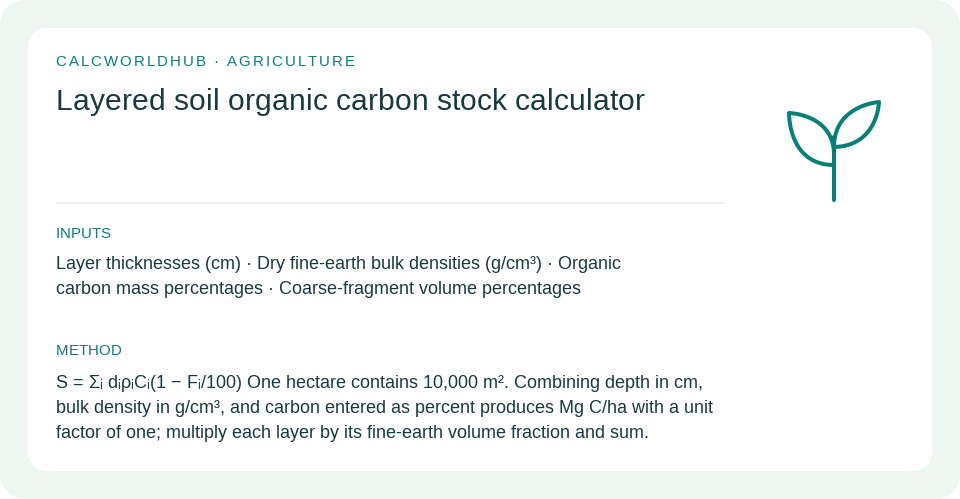
How to use this calculator
Sum carbon inventory across sampled soil layers with an explicit coarse-fragment correction.
- Enter Layer thicknesses (cm), Dry fine-earth bulk densities (g/cm³), Organic carbon mass percentages, Coarse-fragment volume percentages. Match the units shown beside each field and review the result together with the assumptions below.
- Read the worked example below to check the expected input format and result.
- Compare another scenario by changing one input at a time. Use Reset to return to the starting values.
Layered soil organic carbon stock explained
For each layer, multiply thickness by dry fine-earth bulk density, carbon mass percent, and the remaining fine-earth volume; then sum the layer stocks per hectare.
A numerical walkthrough
Layer thicknesses (cm) = 15, 15; Dry fine-earth bulk densities (g/cm³) = 1.2, 1.3; Organic carbon mass percentages = 2, 1; Coarse-fragment volume percentages = 10, 10.
- Layered soil organic carbon stock: 49.95 Mg C/hectare
The upper layer contains 32.4 Mg C/ha and the lower layer 17.55 Mg C/ha under the stated density and fragment convention, totaling 49.95 Mg C/ha.
The model behind the numbers
S = Σᵢ dᵢρᵢCᵢ(1 − Fᵢ/100)
One hectare contains 10,000 m². Combining depth in cm, bulk density in g/cm³, and carbon entered as percent produces Mg C/ha with a unit factor of one; multiply each layer by its fine-earth volume fraction and sum.
What to enter
d— Layer thicknesses (cm)- Thickness of each soil layer in cm. Keep the list aligned position-by-position with density, carbon, and fragment inputs.
b— Dry fine-earth bulk densities (g/cm³)- Dry mass per unit fine-earth volume for each layer, matched to the same position in the other lists.
c— Organic carbon mass percentages- Carbon concentration by dry fine-earth mass for each layer, entered as a percent (for example, 2 for 2%).
f— Coarse-fragment volume percentages- Volume percent of fragments in each layer; the formula applies the remaining fine-earth fraction 1−F/100.
Interpreting the result
Bulk density is defined here per fine-earth volume and carbon percentage on dry fine-earth mass. Do not apply a second fragment correction if density is already whole-soil adjusted.
Frequently asked questions
Does concentration alone determine stock?
No, thickness and dry bulk density are also required.
Can fixed-depth stock changes be misleading?
Yes, changing bulk density can require equivalent-soil-mass comparison.
Is this CO2 credit accounting?
No, it is a stock calculation, not verification or permanence assessment.
How do I use the Layered soil organic carbon stock calculator?
Enter Layer thicknesses (cm), Dry fine-earth bulk densities (g/cm³), Organic carbon mass percentages, Coarse-fragment volume percentages. Match the units shown beside each field and review the result together with the assumptions below.
What is a worked example of Layered soil organic carbon stock?
Layer thicknesses (cm) = 15, 15; Dry fine-earth bulk densities (g/cm³) = 1.2, 1.3; Organic carbon mass percentages = 2, 1; Coarse-fragment volume percentages = 10, 10. Layered soil organic carbon stock: 49.95 Mg C/hectare The upper layer contains 32.4 Mg C/ha and the lower layer 17.55 Mg C/ha under the stated density and fragment convention, totaling 49.95 Mg C/ha.
Method reference: USDA NRCS Rapid Carbon Assessment methodology.
Read our calculation methodology.