How to use this calculator
Evaluate conduction loss along a fin whose thickness decreases linearly from its base to a sharp tip.
- Enter Fin length (m), Fin width (m), Base thickness tapering to zero (m), Fin conductivity (W/m/K), then complete the remaining labeled fields. Match the units shown beside each field and review the result together with the assumptions below.
- Read the worked example below to check the expected input format and result.
- Compare another scenario by changing one input at a time. Use Reset to return to the starting values.
Linearly tapered triangular fin conduction explained
Evaluate conduction loss along a fin whose thickness decreases linearly from its base to a sharp tip.
How the calculation works
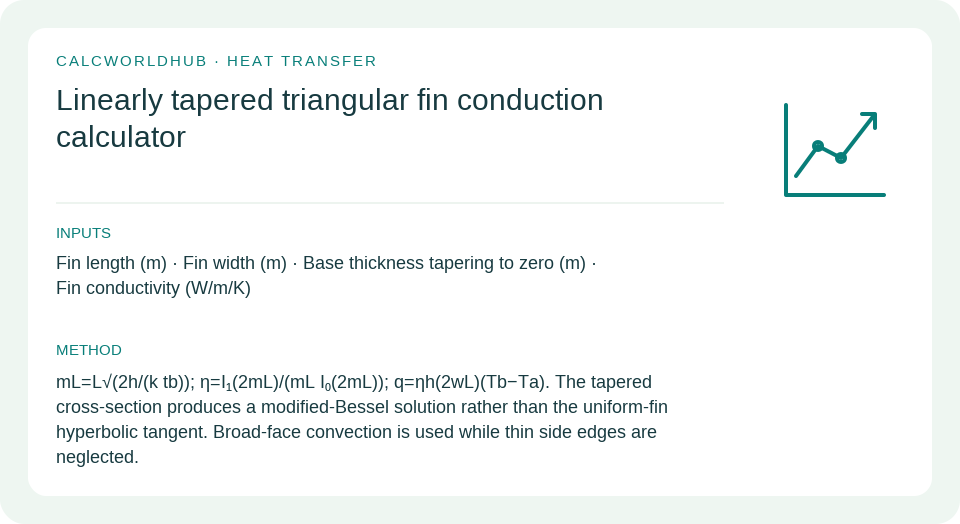
mL=L√(2h/(k tb)); η=I₁(2mL)/(mL I₀(2mL)); q=ηh(2wL)(Tb−Ta).
The tapered cross-section produces a modified-Bessel solution rather than the uniform-fin hyperbolic tangent. Broad-face convection is used while thin side edges are neglected.
Set up the calculation
L— Fin length (m)- Base-to-tip conduction length along the taper; it sets both the fin parameter mL and the broad-face area.
w— Fin width (m)- Fin width perpendicular to the taper direction; the model convects from two broad faces with total area 2wL.
tb— Base thickness tapering to zero (m)- Thickness at the base, decreasing linearly to a sharp zero-thickness tip; it sets the conduction cross-section and fin parameter.
k— Fin conductivity (W/m/K)- Uniform solid thermal conductivity. A higher k conducts more heat toward the tip and changes the Bessel-based efficiency.
hc— Uniform convection coefficient (W/m²/K)- Uniform convection coefficient applied to both broad faces; edge and tip convection are neglected.
Tbase— Fixed base temperature (°C)- Fixed fin-root temperature; together with ambient temperature it sets the driving temperature difference.
Ta— Ambient temperature (°C)- Uniform surrounding-fluid temperature. Heat flow reverses sign if the fin base is colder than the surroundings.
Limits of this model
Thin wide triangular fin, one-dimensional conduction, uniform convection and negligible edge/tip area. No root contact resistance or radiation; mL<100 numerical range.
Check this example
Fin length (m) = 0.05; Fin width (m) = 0.04; Base thickness tapering to zero (m) = 0.003; Fin conductivity (W/m/K) = 180; Uniform convection coefficient (W/m²/K) = 30; Fixed base temperature (°C) = 80; Ambient temperature (°C) = 25.
- Triangular fin efficiency: 0.88271
- Heat transfer from both broad faces: 5.825887 W
A 50 mm long, 40 mm wide fin tapers from 3 mm at its base to an ideal zero-thickness tip. With k=180 W/m/K, h=30 W/m²/K and a 55 K base excess, efficiency is 0.882710 and heat flow is 5.82589 W.
Reading the outputs
Fin efficiency is relative to an isothermal tapered fin; signed heat transfer uses both broad faces.
Frequently asked questions
Why cannot I use the rectangular-fin efficiency?
Tapering changes the conduction area at every position, yielding a different differential equation.
Is the tip thickness an input?
No. This model reaches zero thickness at its mathematical tip.
Does negative heat mean failure?
No. A base colder than ambient receives heat, so the signed outward rate is negative.
How do I use the Linearly tapered triangular fin conduction calculator?
Enter Fin length (m), Fin width (m), Base thickness tapering to zero (m), Fin conductivity (W/m/K), then complete the remaining labeled fields. Match the units shown beside each field and review the result together with the assumptions below.
What is a worked example of Linearly tapered triangular fin conduction?
Fin length (m) = 0.05; Fin width (m) = 0.04; Base thickness tapering to zero (m) = 0.003; Fin conductivity (W/m/K) = 180; Uniform convection coefficient (W/m²/K) = 30; Fixed base temperature (°C) = 80; Ambient temperature (°C) = 25. Triangular fin efficiency: 0.88271 Heat transfer from both broad faces: 5.825887 W A 50 mm long, 40 mm wide fin tapers from 3 mm at its base to an ideal zero-thickness tip. With k=180 W/m/K, h=30 W/m²/K and a 55 K base excess, efficiency is 0.882710 and heat flow is 5.82589 W.
Background or definition reference: IIT NPTEL extended-surface heat-transfer analysis.
Read our calculation methodology.