How to use this calculator
Check guaranteed high- and low-state voltage margins between a logic driver and receiver.
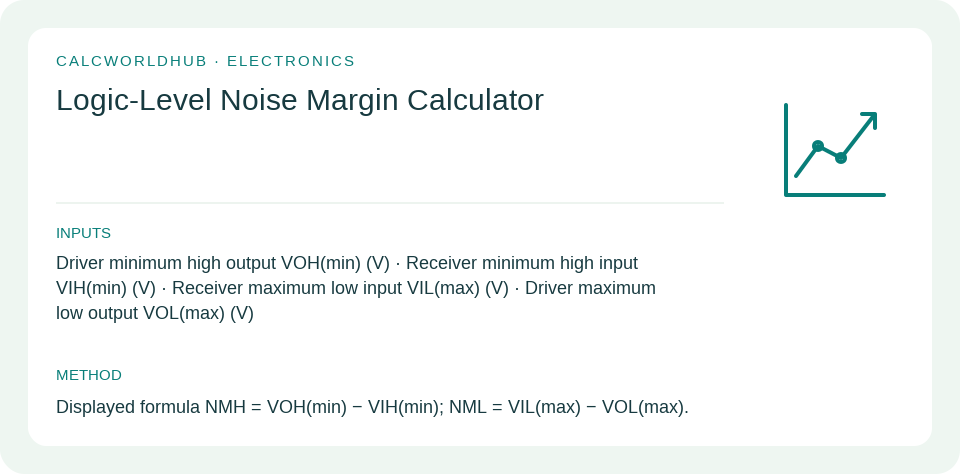
- Enter Driver minimum high output VOH(min) (V), Receiver minimum high input VIH(min) (V), Receiver maximum low input VIL(max) (V), Driver maximum low output VOL(max) (V). Match the units shown beside each field and review the result together with the assumptions below.
- Read the worked example below to check the expected input format and result.
- Compare another scenario by changing one input at a time. Use Reset to return to the starting values.
How this calculation works
Digital logic noise margin measures how much unwanted voltage disturbance can be tolerated while the receiver still sees a valid high or low. The high margin compares the driver's guaranteed minimum high output with the receiver's minimum high input threshold; the low margin compares the receiver's maximum low threshold with the driver's maximum low output.
Inputs and units
vohMinV— Driver minimum high output VOH(min) (V)- Guaranteed minimum high-level output voltage of the driving device.
vihMinV— Receiver minimum high input VIH(min) (V)- Minimum input voltage guaranteed to be recognized as high by the receiving device.
vilMaxV— Receiver maximum low input VIL(max) (V)- Maximum input voltage guaranteed to be recognized as low by the receiving device.
volMaxV— Driver maximum low output VOL(max) (V)- Guaranteed maximum low-level output voltage of the driving device.
Formula
NMH = VOH(min) − VIH(min); NML = VIL(max) − VOL(max).
Method
Use guaranteed data-sheet limits at the relevant supply, load, temperature, and logic family. A negative margin indicates that the stated driver and receiver limits do not guarantee compatibility for that state.
Worked example
For VOH(min) = 4.4 V, VIH(min) = 3.5 V, VIL(max) = 1.5 V, and VOL(max) = 0.4 V, NMH = 0.9 V and NML = 1.1 V.
Assumptions and limits
The result is a static DC threshold check. It does not account for transient noise, ringing, ground shift, output loading beyond the data-sheet conditions, timing, or the uncertain input-voltage region.
Frequently asked questions
What does a negative margin mean?
It means the entered driver and receiver limits do not guarantee a valid logic level for that state.
Which limits should I enter?
Use guaranteed minimum or maximum values from both devices' data sheets under the actual supply and load conditions.
Does this include transient ringing or crosstalk?
No. This calculator checks static voltage thresholds only.
How do I use the Logic-Level Noise Margin Calculator?
Enter Driver minimum high output VOH(min) (V), Receiver minimum high input VIH(min) (V), Receiver maximum low input VIL(max) (V), Driver maximum low output VOL(max) (V). Match the units shown beside each field and review the result together with the assumptions below.
What is a worked example of Logic-Level Noise Margin?
For VOH(min) = 4.4 V, VIH(min) = 3.5 V, VIL(max) = 1.5 V, and VOL(max) = 0.4 V, NMH = 0.9 V and NML = 1.1 V.
Reference: Texas Instruments HCMOS design guide definitions for high- and low-state noise margins. See our calculation methodology.