How to use this calculator
Calculate signed tire longitudinal slip from wheel circumferential speed and vehicle speed.
- Enter Wheel circumferential speed Vw (m/s), Vehicle longitudinal speed Vx (m/s). Match the units shown beside each field and review the result together with the assumptions below.
- Read the worked example below to check the expected input format and result.
- Compare another scenario by changing one input at a time. Use Reset to return to the starting values.
How this calculation works
Longitudinal slip describes the difference between a tire’s circumferential speed and the vehicle’s forward speed during driving or braking.
Inputs and units
wheelSpeed— Wheel circumferential speed Vw (m/s)- Longitudinal tire tread speed estimated from wheel rotation and effective rolling radius.
vehicleSpeed— Vehicle longitudinal speed Vx (m/s)- Positive forward vehicle speed along the tire’s longitudinal direction.
Formula
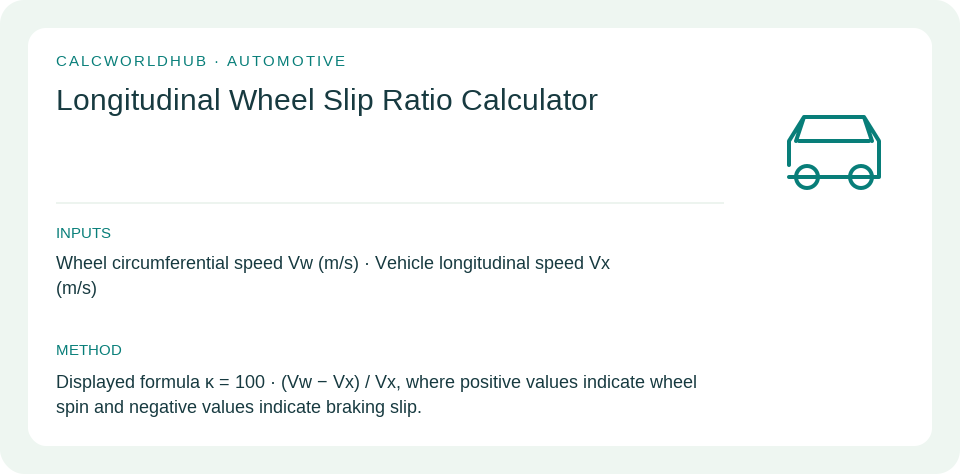
κ = 100 · (Vw − Vx) / Vx, where positive values indicate wheel spin and negative values indicate braking slip.
Method
The calculator divides wheel circumferential speed minus vehicle longitudinal speed by the positive vehicle speed and expresses the result as a signed percentage. This page states its sign and denominator convention explicitly.
Worked example
A wheel circumferential speed of 22.0 m/s at a vehicle speed of 20.0 m/s gives +10.0% drive slip; a lower wheel speed would produce a negative braking-slip value.
Assumptions and limits
Use straight-line speeds in the same units and a positive vehicle speed. Slip-ratio conventions vary across standards and models; this calculator uses vehicle speed as the denominator, reports positive drive slip and negative braking slip, and is not stable at standstill.
Frequently asked questions
Why can the slip ratio be negative?
With this convention, wheel circumferential speed below vehicle speed gives a negative value associated with braking slip.
Why is standstill rejected?
The selected definition divides by vehicle speed, so it is undefined when vehicle speed is zero.
Do all standards use this exact convention?
No. Slip variables differ in denominator and sign across standards and models; compare results only after aligning conventions.
How do I use the Longitudinal Wheel Slip Ratio Calculator?
Enter Wheel circumferential speed Vw (m/s), Vehicle longitudinal speed Vx (m/s). Match the units shown beside each field and review the result together with the assumptions below.
What is a worked example of Longitudinal Wheel Slip Ratio?
A wheel circumferential speed of 22.0 m/s at a vehicle speed of 20.0 m/s gives +10.0% drive slip; a lower wheel speed would produce a negative braking-slip value.
Reference: SAE J670 Vehicle Dynamics Terminology for tire longitudinal slip ratio. See our calculation methodology.