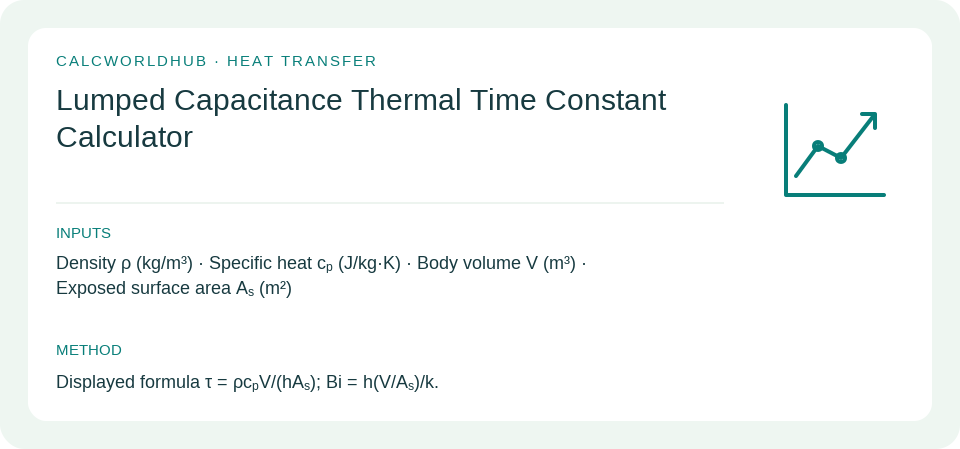
How to use this calculator
Estimate a solid body's lumped thermal time constant and screen the Biot-number assumption.
- Enter Density ρ (kg/m³), Specific heat cₚ (J/kg·K), Body volume V (m³), Exposed surface area Aₛ (m²), then complete the remaining labeled fields. Match the units shown beside each field and review the result together with the assumptions below.
- Read the worked example below to check the expected input format and result.
- Compare another scenario by changing one input at a time. Use Reset to return to the starting values.
How this calculation works
A lumped-capacitance model treats a solid as having a uniform internal temperature that changes over time. Its convective thermal time constant is thermal capacitance divided by surface conductance.
Inputs and units
densityKgM3— Density ρ (kg/m³)- Solid material density.
specificHeatJKgK— Specific heat cₚ (J/kg·K)- Mass-specific heat capacity over the temperature interval of interest.
volumeM3— Body volume V (m³)- Volume of the solid treated as one lumped body.
surfaceAreaM2— Exposed surface area Aₛ (m²)- Surface area participating in convective heat transfer.
hWm2K— Convection coefficient h (W/m²·K)- Representative surface convection heat-transfer coefficient.
conductivityWmK— Thermal conductivity k (W/m·K)- Solid thermal conductivity used for the Biot-number screening check.
Formula
τ = ρcₚV/(hAₛ); Bi = h(V/Aₛ)/k.
Method
Enter density, specific heat, body volume, exposed surface area, convection coefficient, and thermal conductivity in SI units. The calculator estimates τ and evaluates the Biot number with characteristic length V/Aₛ.
Worked example
For ρ=2700 kg/m³, cₚ=900 J/kg·K, V=0.001 m³, Aₛ=0.06 m², h=20 W/m²·K, and k=205 W/m·K, τ is 2,025 s (33.75 min) and Bi is 0.0016.
Assumptions and limits
The lumped model is generally used when Bi ≤ 0.1; larger values indicate internal conduction resistance may matter. The method assumes a uniform convection coefficient and representative material properties and does not solve a spatial temperature field or radiation losses.
Frequently asked questions
What does the time constant mean?
In the ideal lumped model, the temperature difference from the surrounding medium decays exponentially with time constant τ.
What does Biot number screen?
It compares internal conduction resistance with surface convection resistance for the chosen characteristic length.
What if Bi is above 0.1?
The uniform-temperature assumption may be unsuitable; use a transient conduction model that resolves internal temperature gradients.
How do I use the Lumped Capacitance Thermal Time Constant Calculator?
Enter Density ρ (kg/m³), Specific heat cₚ (J/kg·K), Body volume V (m³), Exposed surface area Aₛ (m²), then complete the remaining labeled fields. Match the units shown beside each field and review the result together with the assumptions below.
What is a worked example of Lumped Capacitance Thermal Time Constant?
For ρ=2700 kg/m³, cₚ=900 J/kg·K, V=0.001 m³, Aₛ=0.06 m², h=20 W/m²·K, and k=205 W/m·K, τ is 2,025 s (33.75 min) and Bi is 0.0016.
Reference: Simon Fraser University lumped thermal time constant and Biot criterion. See our calculation methodology.