How to use this calculator
Estimate close-up effective aperture, exposure factor, and stop compensation from lens magnification.
- Enter Marked f-number, Reproduction magnification. Match the units shown beside each field and review the result together with the assumptions below.
- Read the worked example below to check the expected input format and result.
- Compare another scenario by changing one input at a time. Use Reset to return to the starting values.
How this calculation works
For a simple symmetric thin-lens approximation, close focusing increases effective f-number in proportion to one plus reproduction magnification. The corresponding exposure factor is the square of that ratio. This estimate is mainly useful for manual exposure or external metering when through-the-lens metering does not compensate automatically.
Inputs and units
markedFNumber— Marked f-number- Lens f-number before the close-up effective-aperture adjustment.
magnification— Reproduction magnification- Image-to-subject size ratio as a decimal; enter 1 for 1:1.
Formula
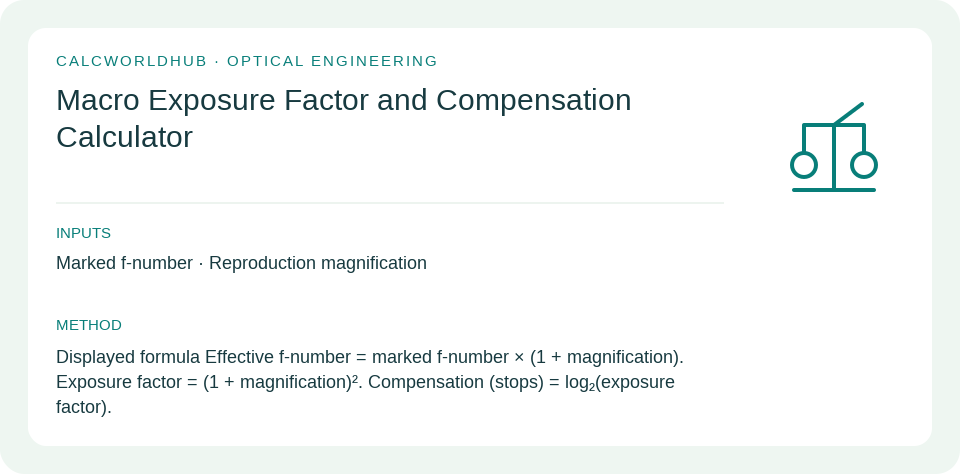
Effective f-number = marked f-number × (1 + magnification). Exposure factor = (1 + magnification)². Compensation (stops) = log₂(exposure factor).
Method
Enter the marked f-number and reproduction magnification as a ratio such as 1 for 1:1. Use the exposure factor or stop value only when the camera or flash workflow requires manual correction.
Worked example
At a marked f/4 and 1:1 magnification, the thin-lens estimate is an effective f/8, a 4× exposure factor, or +2.00 stops if manual correction is needed.
Assumptions and limits
The model assumes a simple symmetric lens and omits pupil magnification, lens-specific close-focus behavior, and transmission losses. Through-the-lens metering often accounts for exposure loss automatically; follow the camera and lens manual.
Frequently asked questions
What does 1:1 magnification mean?
The image on the sensor is the same size as the subject; enter a magnification of 1.
Should I add this compensation when using TTL metering?
Often no. Through-the-lens metering can account for close-focus exposure loss; check the camera and flash setup.
Why can a real lens differ?
Pupil magnification, internal focusing, transmission, and lens design change the close-focus effective aperture.
How do I use the Macro Exposure Factor and Compensation Calculator?
Enter Marked f-number, Reproduction magnification. Match the units shown beside each field and review the result together with the assumptions below.
What is a worked example of Macro Exposure Factor and Compensation?
At a marked f/4 and 1:1 magnification, the thin-lens estimate is an effective f/8, a 4× exposure factor, or +2.00 stops if manual correction is needed.
Reference: Canon macro-lens guidance for magnification, effective f-number, and TTL exposure. See our calculation methodology.