How to use this calculator
Calculate manual-flash aperture or shooting distance from guide number, ISO sensitivity, and the known exposure geometry.
- Enter Guide number at ISO 100, ISO sensitivity, Distance unit, Calculate, then complete the remaining labeled fields. Match the units shown beside each field and review the result together with the assumptions below.
- Read the worked example below to check the expected input format and result.
- Compare another scenario by changing one input at a time. Use Reset to return to the starting values.
How this calculation works
A flash guide number relates flash output, ISO sensitivity, aperture, and subject distance. Enter the guide number specified for the flash's output level and zoom position at ISO 100, then choose whether to solve the aperture for a known subject distance or the range for a known aperture. Keep guide-number and distance units consistent: both meters or both feet.
Inputs and units
guideNumber— Guide number at ISO 100- Enter the flash maker's guide number for the selected output, head zoom, and distance unit (meters or feet).
iso— ISO sensitivity- ISO value used for the exposure; the guide number scales with the square root of ISO/100.
distanceUnit— Distance unit- Choose the same unit used by the guide number and any subject distance.
solveFor— Calculate- Choose aperture when you know the subject distance, or distance when you know the aperture.
knownValue— Known subject distance or f-number- Enter subject distance in the selected unit when calculating aperture, or the f-number when calculating distance.
Formula
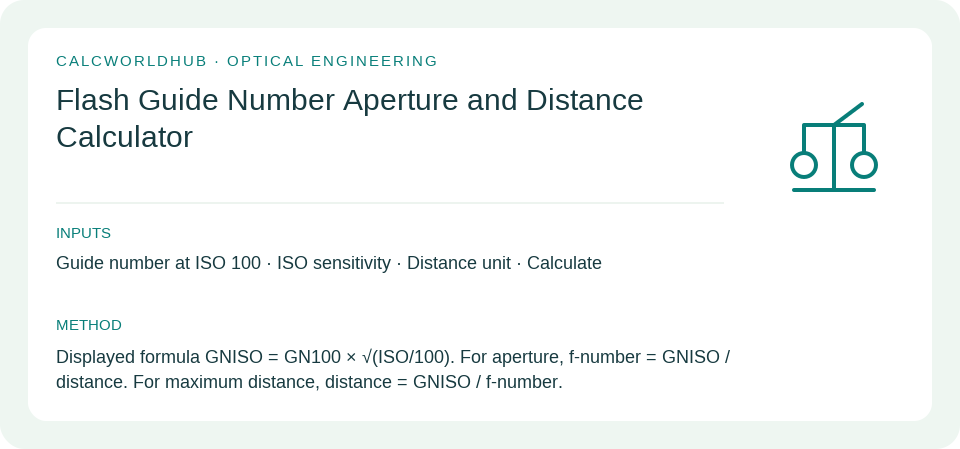
GNISO = GN100 × √(ISO/100). For aperture, f-number = GNISO / distance. For maximum distance, distance = GNISO / f-number.
Method
Scale the ISO 100 guide number by the square root of ISO sensitivity divided by 100. Divide the adjusted guide number by subject distance to get the ideal f-number, or divide it by the selected f-number to get the maximum flash distance.
Worked example
With a 34 m guide number at ISO 100 and a subject 4.25 m away, the calculated aperture is f/8. In the alternate solve mode, the same guide number at f/4 gives an ideal maximum distance of 8.5 m.
Assumptions and limits
Use the guide number for the flash's actual manual output, zoom-head position, illumination pattern, temperature, and distance unit. The result is a nominal direct-flash exposure estimate. It does not model bounce, diffusers, high-speed sync, modifiers, subject reflectance, or camera-metering systems; select the nearest available aperture on the camera.
Frequently asked questions
What is a guide number?
It is a flash-output rating that relates ISO sensitivity, aperture, and flash-to-subject distance under the maker's stated conditions.
Why does ISO change the guide number?
For the usual guide-number relationship, effective guide number scales with the square root of ISO divided by 100.
Can I mix meters and feet?
No. Enter the guide number and subject distance using the same unit. The aperture result itself has no distance unit.
How do I use the Flash Guide Number Aperture and Distance Calculator?
Enter Guide number at ISO 100, ISO sensitivity, Distance unit, Calculate, then complete the remaining labeled fields. Match the units shown beside each field and review the result together with the assumptions below.
What is a worked example of Flash Guide Number Aperture and Distance?
With a 34 m guide number at ISO 100 and a subject 4.25 m away, the calculated aperture is f/8. In the alternate solve mode, the same guide number at f/4 gives an ideal maximum distance of 8.5 m.
Reference: Nikon SB-910 Speedlight manual guide-number and ISO exposure formulas. See our calculation methodology.