How to use this calculator
Convert an aperture, shutter time, and ISO setting into the corresponding exposure value referenced to ISO 100.
- Enter Aperture (f-number), Shutter time (seconds), ISO sensitivity. Match the units shown beside each field and review the result together with the assumptions below.
- Read the worked example below to check the expected input format and result.
- Compare another scenario by changing one input at a time. Use Reset to return to the starting values.
How this calculation works
Exposure value condenses aperture and shutter time into a stop-based number for comparing settings. This calculator also applies the entered ISO to express the combination as EV100. It describes a camera setting combination; it is not a light-meter reading of scene brightness.
Inputs and units
fNumber— Aperture (f-number)- Enter the numeric f-number, such as 2.8, 4, or 8.
shutterSeconds— Shutter time (seconds)- Enter exposure duration in seconds; 1/125 s is about 0.008 s.
iso— ISO sensitivity- Enter the camera or film ISO value.
Formula
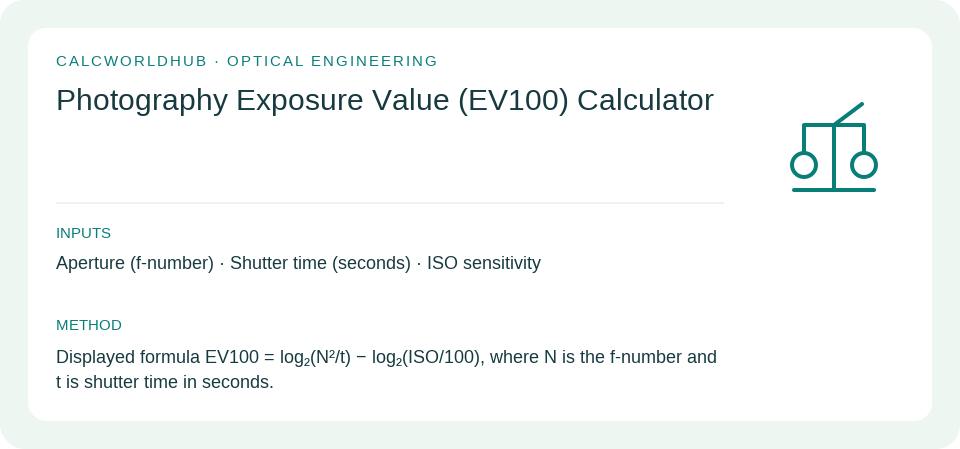
EV100 = log₂(N²/t) − log₂(ISO/100), where N is the f-number and t is shutter time in seconds.
Method
The calculation uses base-2 logarithms because one exposure-value step represents a doubling or halving in exposure. ISO normalization expresses the entered combination at an ISO 100 reference.
Worked example
At f/8, 1/125 s (0.008 s), and ISO 100, EV100 = log₂(8²/0.008) ≈ 12.97.
Assumptions and limits
The estimate treats aperture, shutter time, and ISO as nominal settings. Lens transmission, camera metering calibration, shutter tolerances, and image processing can shift the recorded result.
Frequently asked questions
What does EV100 mean?
It is the exposure value expressed at an ISO 100 reference, so combinations can be compared on a common ISO basis.
Can two different settings have the same EV100?
Yes. A wider aperture paired with a shorter shutter time can preserve the same calculated exposure value, though depth of field and motion rendering change.
Does this tell me whether the scene is correctly exposed?
No. EV100 describes the entered settings, not measured scene luminance or the camera’s metering recommendation.
Why does ISO appear in the formula?
The base aperture-and-time value is normalized to ISO 100 so settings made at another sensitivity can be compared on that reference.
How do I use the Photography Exposure Value (EV100) Calculator?
Enter Aperture (f-number), Shutter time (seconds), ISO sensitivity. Match the units shown beside each field and review the result together with the assumptions below.
Reference: Nikon photography glossary definition of exposure value. See our calculation methodology.