How to use this calculator
Estimate the signal-to-noise ratio after stacking identical CCD exposures, including photon, background, dark, and read noise.
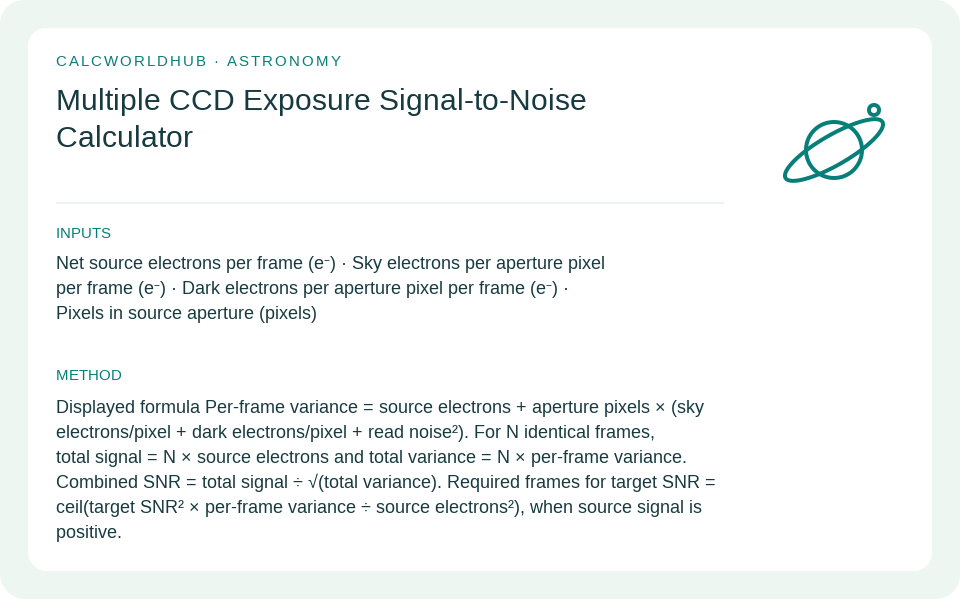
- Enter Net source electrons per frame (e⁻), Sky electrons per aperture pixel per frame (e⁻), Dark electrons per aperture pixel per frame (e⁻), Pixels in source aperture (pixels), then complete the remaining labeled fields. Match the units shown beside each field and review the result together with the assumptions below.
- Read the worked example below to check the expected input format and result.
- Compare another scenario by changing one input at a time. Use Reset to return to the starting values.
How this calculation works
Stacking shorter astronomical exposures can help with cosmic-ray rejection, but each read adds detector noise. Enter per-frame aperture signal and noise terms, the aperture size, and the number and duration of frames to estimate the combined signal-to-noise ratio and the frame count needed for a target.
Inputs and units
sourceElectronsFrame— Net source electrons per frame (e⁻)- Expected source signal inside the photometry aperture in one exposure.
skyElectronsPixel— Sky electrons per aperture pixel per frame (e⁻)- Background photon count per pixel for one exposure; use a nonnegative value.
darkElectronsPixel— Dark electrons per aperture pixel per frame (e⁻)- Dark-current contribution accumulated during one exposure, per aperture pixel.
aperturePixels— Pixels in source aperture (pixels)- Number of detector pixels included in the source aperture.
readNoiseRms— Read noise per pixel per frame (e⁻ RMS)- RMS read noise for one pixel read once in one exposure.
frameCount— Number of stacked exposures- Count of identical independent frames combined in the stack.
exposureSeconds— Exposure time per frame (seconds)- Open-shutter integration time for each exposure, excluding readout overhead.
targetSnr— Target signal-to-noise ratio- Positive SNR goal used to estimate a minimum whole-frame count.
Formula
Per-frame variance = source electrons + aperture pixels × (sky electrons/pixel + dark electrons/pixel + read noise²). For N identical frames, total signal = N × source electrons and total variance = N × per-frame variance. Combined SNR = total signal ÷ √(total variance). Required frames for target SNR = ceil(target SNR² × per-frame variance ÷ source electrons²), when source signal is positive.
Method
All electron quantities refer to one exposure. The aperture signal is the net source estimate; sky and dark values are per aperture pixel. Independent frames add signal and variances, so read-noise variance is incurred once per frame and pixel.
Worked example
With 500 source electrons, 20 sky electrons/pixel, 2 dark electrons/pixel, a 16-pixel aperture, and 5 e⁻ RMS read noise, one frame has variance 500 + 16 × (20 + 2 + 5²) = 1,252 e⁻². Ten frames produce 5,000 source electrons and an SNR of 5,000/√12,520 ≈ 44.69. Reaching an SNR of 45 requires 11 frames under these assumptions.
Assumptions and limits
Assumes identical independent frames, a stable source, linear unsaturated pixels, and a known background level. It does not include uncertainty from estimating the sky background, correlated image noise, cosmic-ray rejection losses, flat-field error, source variability, readout overhead, or instrument-specific detector effects. Use an observatory exposure-time calculator for instrument planning.
Frequently asked questions
Why does each extra frame add read noise?
The detector is read after every exposure. Independent read-noise variances add across frames, even when the source signal also adds.
Does doubling the frame count double SNR?
No. When identical independent frames are stacked, signal grows in proportion to frame count while random-noise standard deviation grows with its square root.
Does total integration time include downloads or dithering?
No. It is the entered exposure duration multiplied by frame count and excludes readout, slew, and other overheads.
Can this replace an observatory exposure-time calculator?
No. Instrument-specific throughput, sky estimation, detector modes, saturation, cosmic-ray rejection, and observing overheads require a facility-specific model.
How do I use the Multiple CCD Exposure Signal-to-Noise Calculator?
Enter Net source electrons per frame (e⁻), Sky electrons per aperture pixel per frame (e⁻), Dark electrons per aperture pixel per frame (e⁻), Pixels in source aperture (pixels), then complete the remaining labeled fields. Match the units shown beside each field and review the result together with the assumptions below.
Reference: STScI Hubble Space Telescope guidance on CCD exposure splitting and read-noise tradeoffs. See our calculation methodology.