How to use this calculator
Estimate the horizontal, vertical, and diagonal sky coverage of a camera sensor on a telescope.
- Enter Camera sensor width (mm), Camera sensor height (mm), Effective focal length (mm). Match the units shown beside each field and review the result together with the assumptions below.
- Read the worked example below to check the expected input format and result.
- Compare another scenario by changing one input at a time. Use Reset to return to the starting values.
How this calculation works
For a camera attached at prime focus, the sensor dimensions and the optic’s effective focal length set the angular field recorded by the frame. This tool calculates all three sensor directions with the exact rectilinear tangent relation, so it can help compare framing without needing the camera pixel pitch.
Inputs and units
sensorWidth— Camera sensor width (mm)- Use the active imaging width, not the outside camera body dimension.
sensorHeight— Camera sensor height (mm)- Use the active imaging height in the same unit as sensor width.
focalLength— Effective focal length (mm)- Enter the focal length after any reducer, extender, or Barlow that changes it.
Formula
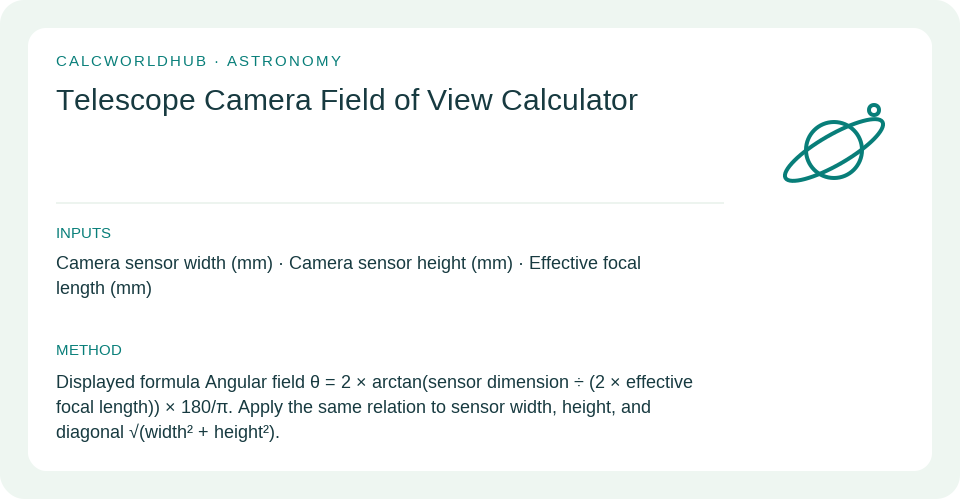
Angular field θ = 2 × arctan(sensor dimension ÷ (2 × effective focal length)) × 180/π. Apply the same relation to sensor width, height, and diagonal √(width² + height²).
Method
Enter width, height, and effective focal length in the same linear unit. The diagonal is calculated from the two sensor sides. Results describe the geometric field at the focal plane and do not depend on pixel count.
Worked example
A 23.5 × 15.7 mm sensor behind a 400 mm optic has a horizontal field of 2 × atan(23.5 ÷ 800) = 3.3652°, a vertical field of 2.2486°, and a diagonal field of 4.0465°.
Assumptions and limits
Assumes a centered rectangular sensor and an ideal rectilinear projection. Optical vignetting, field curvature, distortion, reducer coverage, cropping, sensor rotation, and camera framing margins are not modeled. A lens or telescope may not illuminate the entire calculated sensor field.
Frequently asked questions
Does this need the sensor pixel size?
No. Sensor width and height set the whole-frame field of view; pixel pitch is needed for angular image scale per pixel.
Should I use the telescope’s labeled focal length?
Use the effective focal length of the assembled optical train. A reducer or Barlow can change it.
Why might the corners look darker than this result suggests?
The geometric field can extend beyond the optic’s well-illuminated image circle, so vignetting may reduce usable coverage near the corners.
How do I use the Telescope Camera Field of View Calculator?
Enter Camera sensor width (mm), Camera sensor height (mm), Effective focal length (mm). Match the units shown beside each field and review the result together with the assumptions below.
What is a worked example of Telescope Camera Field of View?
A 23.5 × 15.7 mm sensor behind a 400 mm optic has a horizontal field of 2 × atan(23.5 ÷ 800) = 3.3652°, a vertical field of 2.2486°, and a diagonal field of 4.0465°.
Reference: Sky & Telescope explanation of sensor size and focal length setting camera field of view. See our calculation methodology.