How to use this calculator
Check a homebrew mash's water-to-grain ratio and calculate the volume needed for a chosen thickness.
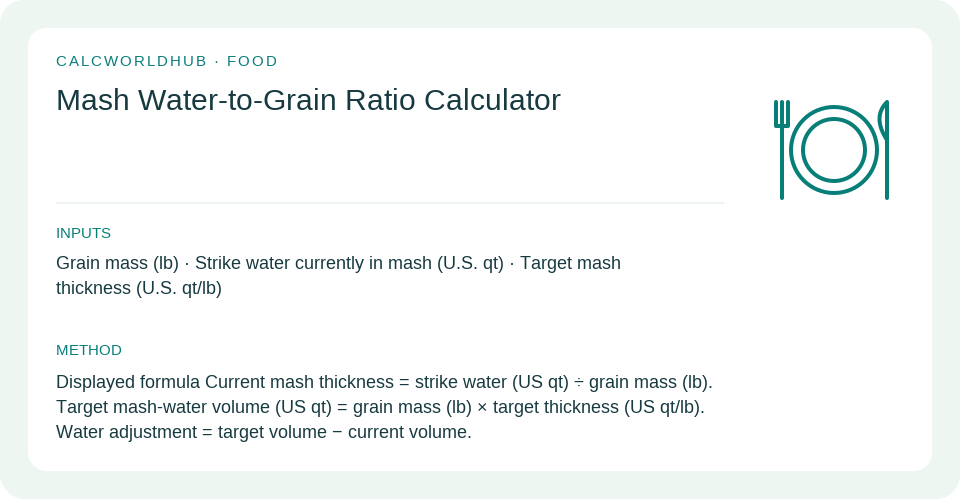
- Enter Grain mass (lb), Strike water currently in mash (U.S. qt), Target mash thickness (U.S. qt/lb). Match the units shown beside each field and review the result together with the assumptions below.
- Read the worked example below to check the expected input format and result.
- Compare another scenario by changing one input at a time. Use Reset to return to the starting values.
How this calculation works
Mash thickness expresses strike-water volume per unit of grist mass. Enter what is in the mash now and a target ratio to see the current thickness and the target water volume; the tool separates this ratio from equipment dead space and later sparge-water planning.
Inputs and units
grainLb— Grain mass (lb)- Enter total grist mass for the mash.
waterQt— Strike water currently in mash (U.S. qt)- Enter the strike-water volume only, before accounting for tun dead space or sparge water.
targetQtPerLb— Target mash thickness (U.S. qt/lb)- Use the ratio specified for your recipe or system.
Formula
Current mash thickness = strike water (US qt) ÷ grain mass (lb). Target mash-water volume (US qt) = grain mass (lb) × target thickness (US qt/lb). Water adjustment = target volume − current volume.
Method
Use grain mass in pounds and strike-water volume in U.S. quarts, then enter the recipe or system's target in U.S. quarts per pound. A positive adjustment means add water to reach the target; a negative adjustment means the current volume is already above it.
Worked example
A 10 lb grist with 15 U.S. qt of strike water is at 1.5 qt/lb. At a target of 1.5 qt/lb, the target volume is 15 qt (3.75 U.S. gal), so no adjustment is needed.
Assumptions and limits
This is a water-to-grist ratio calculation only. It does not calculate mash-tun dead space, grain absorption, strike temperature, sparge volume, boil-off, or batch yield. System recipes and equipment instructions may use different ratios; use the ratio appropriate to your brewing setup.
Frequently asked questions
Does this include mash-tun dead space?
No. It calculates water-to-grist ratio only; add equipment dead space separately when planning total vessel volume.
What does a negative water adjustment mean?
The entered strike-water volume is above the target ratio, so the arithmetic difference is negative.
Is the target ratio universal?
No. Recipe design, vessel geometry, sparging method, and equipment can call for different ratios. Use the target chosen for your system.
Does the result include sparge water?
No. Sparge volume depends on batch volume, grain absorption, losses, and equipment; those are separate calculations.
How do I use the Mash Water-to-Grain Ratio Calculator?
Enter Grain mass (lb), Strike water currently in mash (U.S. qt), Target mash thickness (U.S. qt/lb). Match the units shown beside each field and review the result together with the assumptions below.
Reference: Grainfather guidance on mash and sparge water-volume calculations. See our calculation methodology.