How to use this calculator
Normalize a meteor count for observing time, limiting magnitude, radiant altitude, and sky obstruction.
- Enter Shower meteors observed, Effective observing time (hours), Meteor population index r, Limiting stellar magnitude, then complete the remaining labeled fields. Match the units shown beside each field and review the result together with the assumptions below.
- Read the worked example below to check the expected input format and result.
- Compare another scenario by changing one input at a time. Use Reset to return to the starting values.
How this calculation works
The zenithal hourly rate is an idealized comparison rate adjusted for observing conditions. A higher limiting magnitude means fainter meteors are visible, while a low radiant altitude reduces the effective count because fewer shower meteors are favorably positioned.
Inputs and units
count— Shower meteors observed- Count only meteors assigned to the shower during the effective interval.
hours— Effective observing time (hours)- Time actually spent observing under the stated conditions.
population— Meteor population index r- Brightness-distribution factor for the shower; use a value greater than zero.
limiting— Limiting stellar magnitude- Faintest stars reliably visible at the observing location.
altitude— Radiant altitude above horizon (degrees)- Altitude during the effective interval; must be above the horizon.
factor— Obstruction / cloud correction factor F- Enter the observation correction factor; use 1.0 when no correction is applied.
Formula
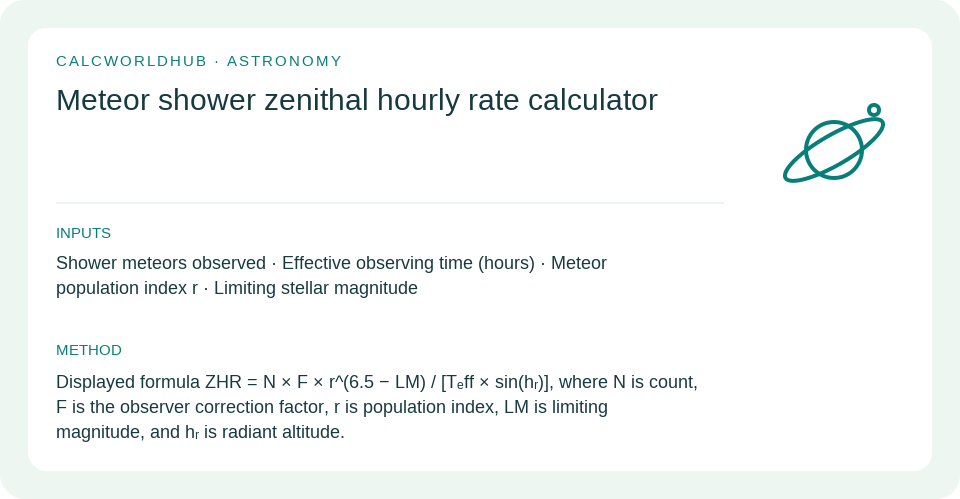
ZHR = N × F × r^(6.5 − LM) / [Tₑff × sin(hᵣ)], where N is count, F is the observer correction factor, r is population index, LM is limiting magnitude, and hᵣ is radiant altitude.
Method
Enter the observed shower meteor count, effective observing hours, population index, limiting stellar magnitude, radiant altitude above the horizon, and a correction factor for obstruction/clouds. This simplified form uses a first-power radiant-height correction.
Worked example
For 24 shower meteors in 1.5 effective hours, r = 2, limiting magnitude 6, radiant altitude 60°, and F = 1.2, ZHR = 24 × 1.2 × 2^0.5 / (1.5 × sin 60°) ≈ 31.35 meteors per hour.
Assumptions and limits
This is an approximate visual-observation normalization, not a forecast of what one observer will see. Small counts create large uncertainty; the result is sensitive to population index and magnitude estimate. It assumes a clear defined field and the stated simple altitude correction, and should not be compared across incompatible observing methods without care.
Frequently asked questions
What does ZHR mean?
It is an idealized rate normalized to a radiant near the zenith, dark limiting magnitude 6.5, and unobstructed sky assumptions.
Why does the limiting magnitude affect the result?
The population index adjusts the count for the difference between the observed faint-star limit and the reference magnitude.
Can I use the result as a predicted count?
No. It normalizes an observation; actual counts depend on shower activity, sky conditions, observer skill, and sampling uncertainty.
What should I enter for F?
Use the correction factor defined by your observing method; enter 1 when no obstruction or cloud correction is applied.
How do I use the Meteor shower zenithal hourly rate calculator?
Enter Shower meteors observed, Effective observing time (hours), Meteor population index r, Limiting stellar magnitude, then complete the remaining labeled fields. Match the units shown beside each field and review the result together with the assumptions below.
Reference: International Meteor Organization ZHR and flux-density method. See our calculation methodology.