How to use this calculator
Estimate local sunrise, sunset, solar noon, and daylight duration from a date, coordinates, and UTC offset.
- Enter Year, Month, Day of month, Latitude (°), then complete the remaining labeled fields. Match the units shown beside each field and review the result together with the assumptions below.
- Read the worked example below to check the expected input format and result.
- Compare another scenario by changing one input at a time. Use Reset to return to the starting values.
How this calculation works
Solar time depends on both the date and longitude. Enter a Gregorian date, latitude and longitude in decimal degrees, and the location’s UTC offset for that date to estimate the Sun’s daily horizon crossings.
Inputs and units
year— Year- Gregorian calendar year from 1900 to 2100.
month— Month- Calendar month, 1–12.
day— Day of month- Calendar day; must exist in the selected month.
latitude— Latitude (°)- North positive, south negative; from −90° to 90°.
longitude— Longitude (°)- East positive, west negative; from −180° to 180°.
offset— UTC offset for local clock (hours)- Local time minus UTC on the selected date; includes DST if applicable.
Formula
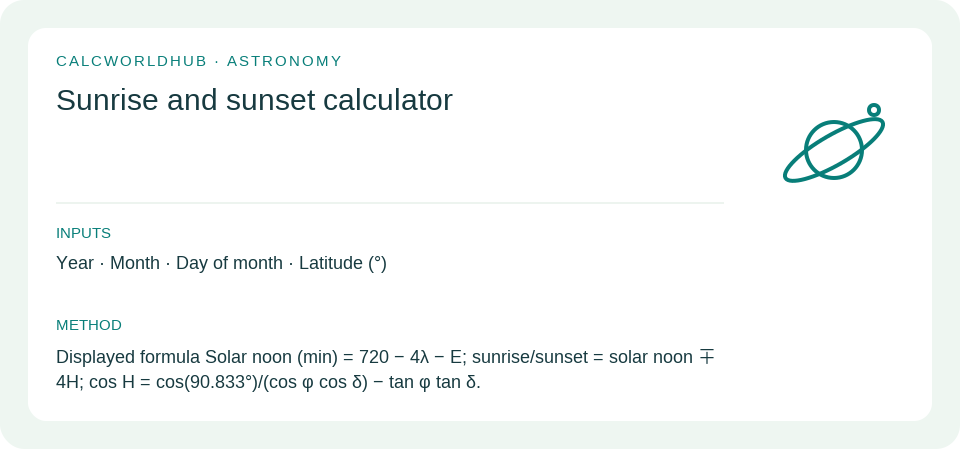
Solar noon (min) = 720 − 4λ − E; sunrise/sunset = solar noon ∓ 4H; cos H = cos(90.833°)/(cos φ cos δ) − tan φ tan δ.
Method
E is the equation of time in minutes, δ is solar declination, φ is latitude, λ is east-positive longitude, and H is the sunrise hour angle. The 90.833° zenith approximates the solar disk and atmospheric refraction.
Worked example
For New York City (40.7128° N, 74.006° W), June 21, 2025, and UTC−4, the NOAA-style estimate is about 5:24 AM sunrise, 12:57 PM solar noon, 8:30 PM sunset, and 15.10 hours of daylight.
Assumptions and limits
The NOAA-style approximation gives local clock estimates, not a site-specific horizon prediction. Enter the UTC offset in force on the requested date, including daylight saving time where applicable. Terrain, elevation, atmospheric conditions, and local obstruction are not modeled; polar dates may have no sunrise or sunset.
Frequently asked questions
Why do I enter a UTC offset?
The offset turns solar time into an approximate local clock time. Daylight saving changes the offset on some dates.
Why does the horizon use 90.833 degrees?
That standard sunrise/sunset convention approximates the visible solar disk and atmospheric refraction.
Will mountains change the result?
Yes. The calculation assumes a flat, unobstructed horizon and does not include terrain or local obstacles.
How do I use the Sunrise and sunset calculator?
Enter Year, Month, Day of month, Latitude (°), then complete the remaining labeled fields. Match the units shown beside each field and review the result together with the assumptions below.
What is a worked example of Sunrise and sunset?
For New York City (40.7128° N, 74.006° W), June 21, 2025, and UTC−4, the NOAA-style estimate is about 5:24 AM sunrise, 12:57 PM solar noon, 8:30 PM sunset, and 15.10 hours of daylight.
Reference: NOAA Global Monitoring Laboratory solar-calculation reference. See our calculation methodology.