How to use this calculator
Estimate the single-pulse echo from a specified point-target cross section before adding pulse integration or detection processing.
- Enter Peak transmit power (W), Shared transmit and receive antenna gain (dBi), Carrier frequency (Hz), Point-target radar cross section (m2), then complete the remaining labeled fields. Match the units shown beside each field and review the result together with the assumptions below.
- Read the worked example below to check the expected input format and result.
- Compare another scenario by changing one input at a time. Use Reset to return to the starting values.
Monostatic point-target radar echo budget explained
How the calculation works
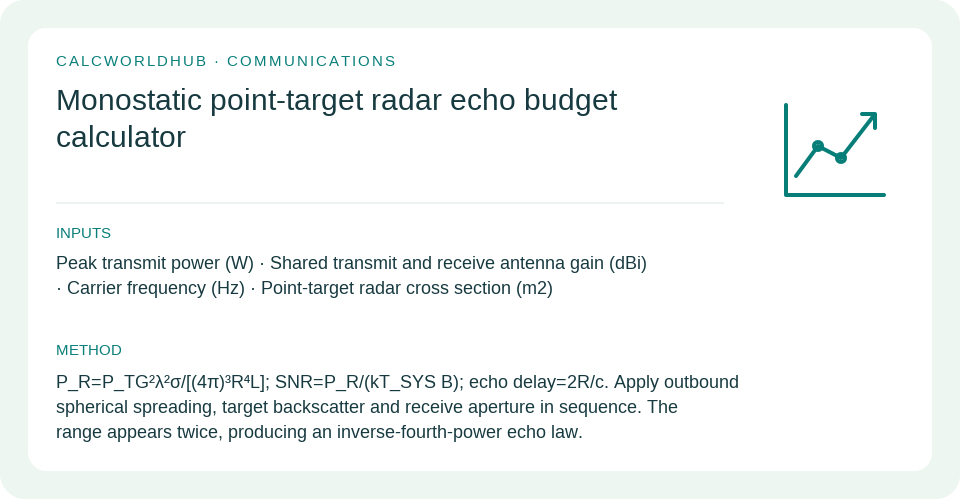
P_R=P_TG²λ²σ/[(4π)³R⁴L]; SNR=P_R/(kT_SYS B); echo delay=2R/c.
Apply outbound spherical spreading, target backscatter and receive aperture in sequence. The range appears twice, producing an inverse-fourth-power echo law.
Set up the calculation
Pt— Peak transmit power (W)- Power delivered during the radar pulse.
G— Shared transmit and receive antenna gain (dBi)- Peak directional gain used on both outward and return paths.
f— Carrier frequency (Hz)- Frequency setting the radar wavelength.
sigma— Point-target radar cross section (m2)- Backscatter cross section in the actual target aspect and polarization.
r— Target slant range (m)- One-way radar-to-target distance.
loss— Combined additional radar loss (dB)- Nonnegative losses other than geometric spreading.
Tsys— Receive system noise temperature (K)- Equivalent total noise temperature at the receive reference plane.
B— Receive noise bandwidth (Hz)- Bandwidth for the reported instantaneous pulse SNR.
Limits of this model
Far-field isolated point target, equal transmit/receive gain, specified RCS and no multipath. Clutter, probability of detection, pulse compression and coherent integration are excluded.
Check this example
Peak transmit power (W) = 1000; Shared transmit and receive antenna gain (dBi) = 30; Carrier frequency (Hz) = 10000000000; Point-target radar cross section (m2) = 1; Target slant range (m) = 10000; Combined additional radar loss (dB) = 6; Receive system noise temperature (K) = 500; Receive noise bandwidth (Hz) = 1000000.
- Received peak echo power: 1.13765823e-14 W
- Unintegrated echo SNR: 1.648005 linear
- Round-trip propagation delay: 0.000067 s
A 1 kW, 10 GHz radar with 30 dBi gain observing a 1 m² target at 10 km receives a weak echo despite the large transmitted peak power.
Reading the outputs
Echo power is peak received watts during the return pulse; SNR is linear before integration. Delay is the two-way flight time.
Frequently asked questions
Can average transmitter power replace peak power?
Only for a correspondingly averaged echo model; this page reports the echo while the pulse is present.
Does doubling range halve echo power?
It reduces the ideal point-target echo by sixteen, before any extra propagation loss.
Is one square metre RCS the same as a one-square-metre silhouette?
No; RCS depends on shape, material, aspect, frequency and polarization.
How do I use the Monostatic point-target radar echo budget calculator?
Enter Peak transmit power (W), Shared transmit and receive antenna gain (dBi), Carrier frequency (Hz), Point-target radar cross section (m2), then complete the remaining labeled fields. Match the units shown beside each field and review the result together with the assumptions below.
What is a worked example of Monostatic point-target radar echo budget?
Peak transmit power (W) = 1000; Shared transmit and receive antenna gain (dBi) = 30; Carrier frequency (Hz) = 10000000000; Point-target radar cross section (m2) = 1; Target slant range (m) = 10000; Combined additional radar loss (dB) = 6; Receive system noise temperature (K) = 500; Receive noise bandwidth (Hz) = 1000000. Received peak echo power: 1.13765823e-14 W Unintegrated echo SNR: 1.648005 linear Round-trip propagation delay: 0.000067 s A 1 kW, 10 GHz radar with 30 dBi gain observing a 1 m² target at 10 km receives a weak echo despite the large transmitted peak power.
Background or definition reference: NASA radar systems short course.
Read our calculation methodology.