How to use this calculator
Separate delay and motion from signed up/down chirp beat measurements using an explicit triangular-FMCW convention.
- Enter Carrier frequency (Hz), Positive chirp-slope magnitude (Hz/s), Signed up-chirp beat (Hz), Signed down-chirp beat (Hz), then complete the remaining labeled fields. Match the units shown beside each field and review the result together with the assumptions below.
- Read the worked example below to check the expected input format and result.
- Compare another scenario by changing one input at a time. Use Reset to return to the starting values.
Triangular FMCW paired-beat range and speed explained
Paired beats from matched up and down FMCW chirps separate time-delay and Doppler contributions. Their signed sum determines one-way range, while their signed difference determines radial velocity under the stated convention. Swept bandwidth supplies a separate ideal range-resolution estimate.
Inputs, symbols, and units
f— Carrier frequency (Hz)- Carrier frequency for the velocity conversion.
slope— Positive chirp-slope magnitude (Hz/s)- Magnitude of linear up/down chirp slope.
up— Signed up-chirp beat (Hz)- Beat convention f_up=Sτ−fD.
down— Signed down-chirp beat (Hz)- Sign-corrected down-chirp convention f_down=Sτ+fD.
band— Swept RF bandwidth (Hz)- Useful bandwidth of one chirp for range-resolution estimate.
Formula and method
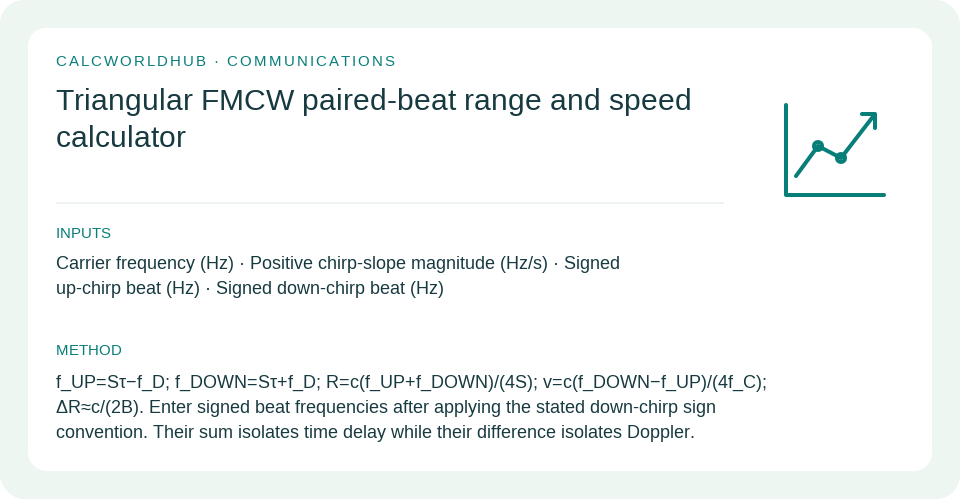
f_UP=Sτ−f_D; f_DOWN=Sτ+f_D; R=c(f_UP+f_DOWN)/(4S); v=c(f_DOWN−f_UP)/(4f_C); ΔR≈c/(2B).
Enter signed beat frequencies after applying the stated down-chirp sign convention. Their sum isolates time delay while their difference isolates Doppler.
A worked scenario
Carrier frequency (Hz) = 77000000000; Positive chirp-slope magnitude (Hz/s) = 2.00000000e+12; Signed up-chirp beat (Hz) = 700000; Signed down-chirp beat (Hz) = 900000; Swept RF bandwidth (Hz) = 1000000000.
- Target range: 59.958492 m
- Closing radial speed: 194.670427 m/s
- Ideal bandwidth range resolution: 0.149896 m
At 77 GHz with slope 2×10^12 Hz/s, paired beats of 700 and 900 kHz indicate both nonzero range and approach speed.
Assumptions and edge cases
Matched up/down slopes and one correctly paired constant-speed target below 0.01c. Magnitude-only beats, multiple-target association and range migration can invalidate inversion.
Reading the outputs
Range is one-way target distance. Positive radial speed means closing. Resolution is a bandwidth estimate and is distinct from estimation accuracy.
Frequently asked questions
Can I enter only positive FFT peak magnitudes?
Only when your processing has resolved the sign and your convention matches these equations; magnitude-only peaks can be ambiguous.
Why is bandwidth resolution not my range error?
Resolution describes separating nearby targets; SNR, calibration and estimation method determine uncertainty.
What if the two beats belong to different targets?
The algebra still produces numbers but they have no physical association, so pair targets before using it.
How do I use the Triangular FMCW paired-beat range and speed calculator?
Enter Carrier frequency (Hz), Positive chirp-slope magnitude (Hz/s), Signed up-chirp beat (Hz), Signed down-chirp beat (Hz), then complete the remaining labeled fields. Match the units shown beside each field and review the result together with the assumptions below.
What is a worked example of Triangular FMCW paired-beat range and speed?
Carrier frequency (Hz) = 77000000000; Positive chirp-slope magnitude (Hz/s) = 2.00000000e+12; Signed up-chirp beat (Hz) = 700000; Signed down-chirp beat (Hz) = 900000; Swept RF bandwidth (Hz) = 1000000000. Target range: 59.958492 m Closing radial speed: 194.670427 m/s Ideal bandwidth range resolution: 0.149896 m At 77 GHz with slope 2×10^12 Hz/s, paired beats of 700 and 900 kHz indicate both nonzero range and approach speed.
Background or definition reference: NASA FMCW range and vector velocity measurements.
Read our calculation methodology.