How to use this calculator
Estimate the heat leak and floating temperatures of a reflective shield stack between large parallel surfaces.
- Enter Hot plate temperature (K), Cold plate temperature (K), Hot plate emissivity, Cold plate emissivity, then complete the remaining labeled fields. Match the units shown beside each field and review the result together with the assumptions below.
- Read the worked example below to check the expected input format and result.
- Compare another scenario by changing one input at a time. Use Reset to return to the starting values.
Multiple floating radiation shields between plates explained
For large parallel grey surfaces, each freely floating shield adds radiative resistance between the hot and cold plates. This calculation assumes uniform temperatures, diffuse-gray exchange, identical shield emissivity on both faces, and no conduction or convection through the gaps.
Inputs, symbols, and units
Th— Hot plate temperature (K)- Hot plate temperature (K). Enter the value for this state; the units shown are used without an unstated conversion.
Tc— Cold plate temperature (K)- Cold plate temperature (K). Enter the value for this state; the units shown are used without an unstated conversion.
e1— Hot plate emissivity- Hot plate emissivity. Enter the value for this state; the units shown are used without an unstated conversion.
e2— Cold plate emissivity- Cold plate emissivity. Enter the value for this state; the units shown are used without an unstated conversion.
es— Both-face shield emissivity- Both-face shield emissivity. Enter the value for this state; the units shown are used without an unstated conversion.
N— Number of floating shields- Number of floating shields. Enter the value for this state; the units shown are used without an unstated conversion. Enter a whole number.
A— Common exchange area (m²)- Common exchange area (m²). Enter the value for this state; the units shown are used without an unstated conversion.
Formula and method
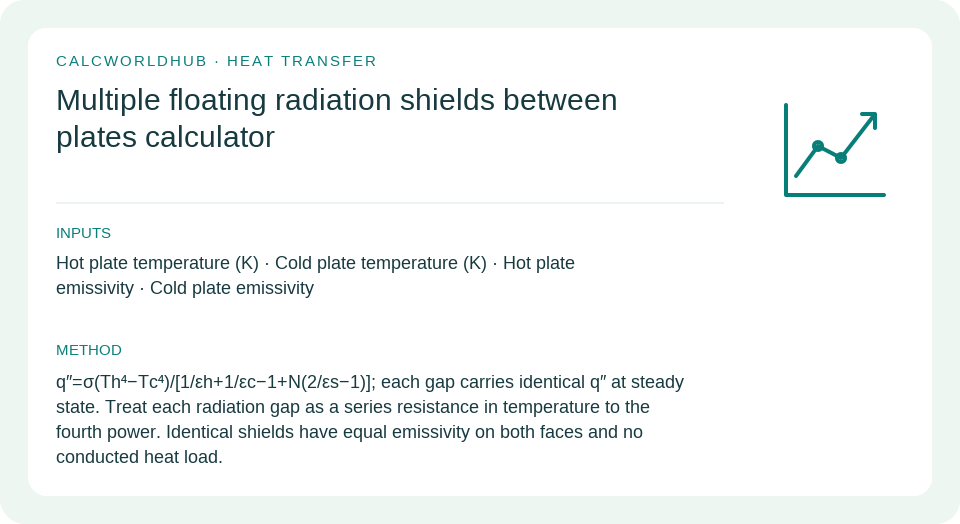
q″=σ(Th⁴−Tc⁴)/[1/εh+1/εc−1+N(2/εs−1)]; each gap carries identical q″ at steady state.
Treat each radiation gap as a series resistance in temperature to the fourth power. Identical shields have equal emissivity on both faces and no conducted heat load.
A worked scenario
Hot plate temperature (K) = 800; Cold plate temperature (K) = 300; Hot plate emissivity = 0.8; Cold plate emissivity = 0.8; Both-face shield emissivity = 0.1; Number of floating shields = 3; Common exchange area (m²) = 1.
- Radiation through shield stack: 389.171851 W/m²
- Total radiation heat rate: 389.171851 W
- Hot-side floating shield temperature: 763.186204 K
- Cold-side floating shield temperature: 529.231726 K
Three floating shields of emissivity 0.1 between 800 and 300 K plates reduce the ideal radiative flux to 389.172 W/m². The first and last shields float at 763.186 and 529.232 K rather than sharing the plate temperatures.
Assumptions and edge cases
Large parallel diffuse gray plates, unit mutual view, negligible edge effects, no convection or support conduction and each shield is isothermal.
Reading the outputs
Flux and total heat are W/m² and W; first and last shield temperatures are K. With zero shields the displayed endpoints are the plate temperatures.
Frequently asked questions
Does shield spacing enter the formula?
Not for ideal large plates in a nonparticipating medium. Edge geometry and gas conduction can make spacing important in hardware.
Why do low-emissivity shields work?
They add radiative resistance through reflection on both faces.
Can I give a shield an imposed temperature?
No. These shields float thermally; actively cooled shields need prescribed-temperature node balances.
How do I use the Multiple floating radiation shields between plates calculator?
Enter Hot plate temperature (K), Cold plate temperature (K), Hot plate emissivity, Cold plate emissivity, then complete the remaining labeled fields. Match the units shown beside each field and review the result together with the assumptions below.
What is a worked example of Multiple floating radiation shields between plates?
Hot plate temperature (K) = 800; Cold plate temperature (K) = 300; Hot plate emissivity = 0.8; Cold plate emissivity = 0.8; Both-face shield emissivity = 0.1; Number of floating shields = 3; Common exchange area (m²) = 1. Radiation through shield stack: 389.171851 W/m² Total radiation heat rate: 389.171851 W Hot-side floating shield temperature: 763.186204 K Cold-side floating shield temperature: 529.231726 K Three floating shields of emissivity 0.1 between 800 and 300 K plates reduce the ideal radiative flux to 389.172 W/m². The first and last shields float at 763.186 and 529.232 K rather than sharing the plate temperatures.
Background or definition reference: IIT NPTEL radiation shields.
Read our calculation methodology.