How to use this calculator
Compare a tax-exempt municipal yield with the taxable yield that would leave the same after-tax return.
- Enter Tax-exempt municipal yield, Marginal tax rate. Match the units shown beside each field and review the result together with the assumptions below.
- Read the worked example below to check the expected input format and result.
- Compare another scenario by changing one input at a time. Use Reset to return to the starting values.
How this calculation works
A municipal bond’s quoted yield and a taxable bond’s quoted yield are not directly comparable when their interest receives different tax treatment. This calculator expresses an entered tax-exempt yield as a taxable-equivalent yield using the marginal tax rate supplied by the user.
Inputs and units
municipalYield— Tax-exempt municipal yield- Annual yield in percent; enter 3.5 for 3.5%, not 0.035.
marginalTaxRate— Marginal tax rate- Marginal rate in percent from 0% to below 100%.
Formula
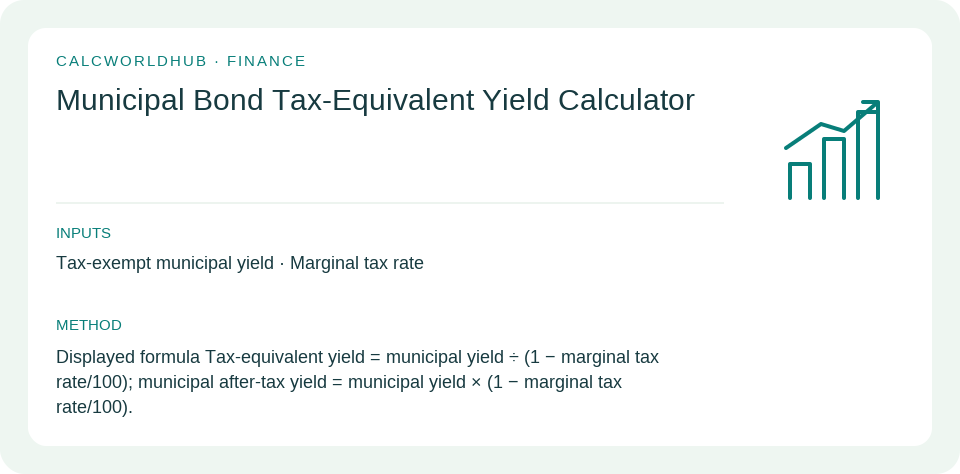
Tax-equivalent yield = municipal yield ÷ (1 − marginal tax rate/100); municipal after-tax yield = municipal yield × (1 − marginal tax rate/100).
Method
Enter the yield and marginal tax rate as percentages, for example 3.5 and 35.8. The tax rate is converted to a fraction. The first result is the pre-tax taxable yield that would match the entered municipal yield after tax under the simple model; the second is the municipal yield after applying that rate.
Worked example
With a 3.5% municipal yield and a 35.8% marginal rate, tax-equivalent yield = 3.5 ÷ (1 − 0.358) ≈ 5.45%. The simplified after-tax municipal yield is 3.5 × 0.642 = 2.247%.
Assumptions and limits
This is an illustrative comparison, not tax or investment advice. It assumes the municipal yield is fully exempt from the entered tax and applies one marginal rate. State and local tax treatment, alternative minimum tax, tax brackets, account type, fees, credit risk, call risk, and market-price changes are not modeled.
Frequently asked questions
What does tax-equivalent yield tell me?
It estimates the taxable bond yield needed to match a tax-exempt yield after applying the entered marginal tax rate.
Should I enter a percentage or decimal tax rate?
Enter a percentage number, such as 24 or 35.8. The calculator converts it to a decimal internally.
Does this decide whether a municipal bond is a better investment?
No. It compares a simplified tax effect only. Credit quality, duration, liquidity, call terms, fees, and your actual tax situation also matter.
How do I use the Municipal Bond Tax-Equivalent Yield Calculator?
Enter Tax-exempt municipal yield, Marginal tax rate. Match the units shown beside each field and review the result together with the assumptions below.
What is a worked example of Municipal Bond Tax-Equivalent Yield?
With a 3.5% municipal yield and a 35.8% marginal rate, tax-equivalent yield = 3.5 ÷ (1 − 0.358) ≈ 5.45%. The simplified after-tax municipal yield is 3.5 × 0.642 = 2.247%.
Reference: New York Life Investment Management tax-equivalent yield method. See our calculation methodology.