How to use this calculator
Estimate a short-term Treasury bill's purchase price from its discount rate, then compare the discount quote with an annualized investment yield.
- Enter Face value ($), Annual bank discount rate (%), Days to maturity, Days in annualization year. Match the units shown beside each field and review the result together with the assumptions below.
- Read the worked example below to check the expected input format and result.
- Compare another scenario by changing one input at a time. Use Reset to return to the starting values.
How this calculation works
A Treasury bill pays its face value at maturity and is commonly purchased below that amount. The discount-rate quote uses a 360-day convention; the simple investment-yield comparison uses the actual number of days and a 365- or 366-day year basis.
Inputs and units
face— Face value ($)- Amount payable at maturity, before any tax treatment.
discountRate— Annual bank discount rate (%)- Enter the quoted annual discount rate as a percentage.
days— Days to maturity- Use the actual number of calendar days from issue/settlement to maturity; supported range is 1–182.
yearDays— Days in annualization year- Use 366 when the applicable year basis includes February 29; otherwise use 365.
Formula
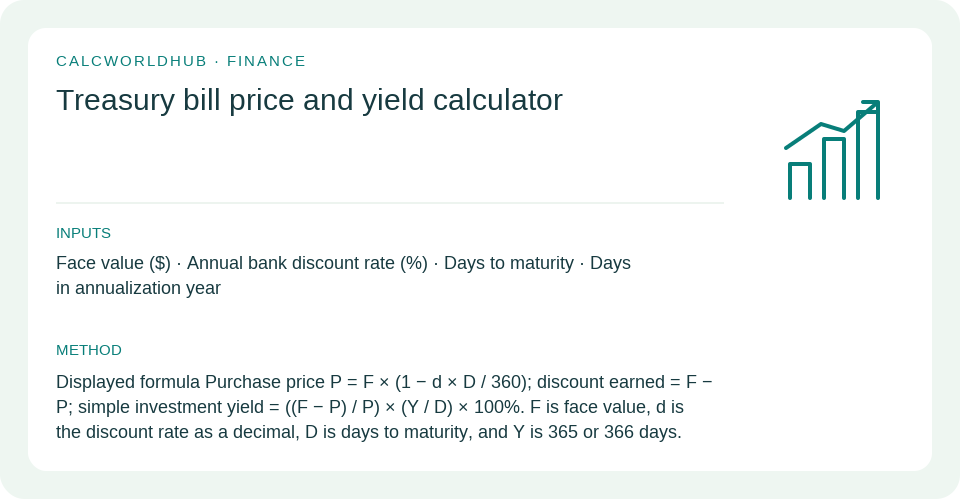
Purchase price P = F × (1 − d × D / 360); discount earned = F − P; simple investment yield = ((F − P) / P) × (Y / D) × 100%. F is face value, d is the discount rate as a decimal, D is days to maturity, and Y is 365 or 366 days.
Method
The purchase price follows TreasuryDirect's discount-rate pricing equation. For bills with no more than half a year to maturity, the annualized investment rate compares the discount with the cash price and scales by the entered calendar-year day count.
Worked example
For a $10,000 face-value bill with a 5.32% discount rate, 91 days to maturity, and a 365-day annualization basis, the estimated price is $9,865.52. The $134.48 discount corresponds to a simple annualized investment yield of about 5.4674%.
Assumptions and limits
This estimate is for a bill priced from a discount rate with 1–182 days remaining. It excludes auction price increments, bid allocation, secondary-market costs, taxes, settlement conventions, and reinvestment. Use the actual auction or broker price for a purchase decision; the yield is an annualized comparison, not a promised return on another product.
Frequently asked questions
Why are the discount rate and investment yield different?
The discount quote divides the discount by face value and uses a 360-day year. The investment yield divides by the cash price and annualizes on a 365- or 366-day basis.
Is the yield a forecast of future Treasury rates?
No. It annualizes the price-to-face-value difference for this bill's stated days to maturity; it does not predict auction rates or reinvestment returns.
Why is the day count limited to 182?
The simple investment-rate relationship used here is intended for bills with no more than about half a year remaining. Longer maturities use a different conversion convention.
Does the calculator use current auction rates?
No. Enter a discount quote or a scenario rate; current auction results change over time and should be checked separately.
How do I use the Treasury bill price and yield calculator?
Enter Face value ($), Annual bank discount rate (%), Days to maturity, Days in annualization year. Match the units shown beside each field and review the result together with the assumptions below.
Reference: U.S. TreasuryDirect Treasury bill pricing and discount-rate formula. See our calculation methodology.