How to use this calculator
Estimate how a negative test result changes disease odds using sensitivity and specificity measured at the same threshold in the same population.
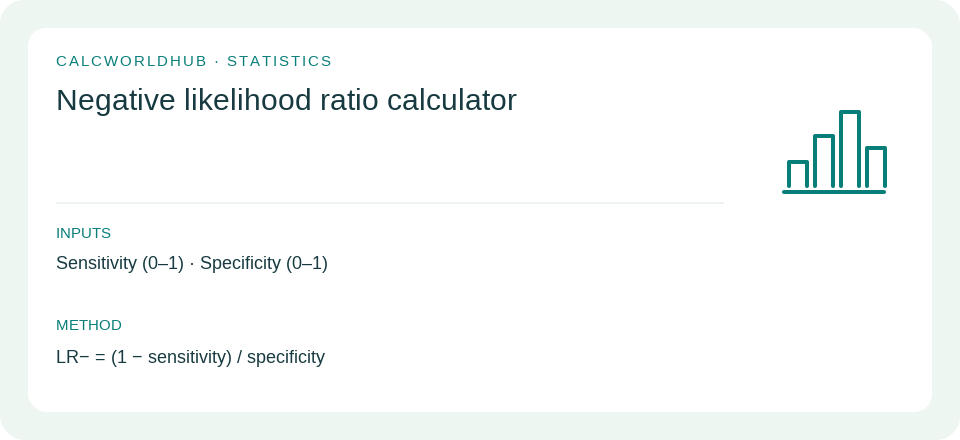
- Enter Sensitivity (0–1), Specificity (0–1). Match the units shown beside each field and review the result together with the assumptions below.
- Read the worked example below to check the expected input format and result.
- Compare another scenario by changing one input at a time. Use Reset to return to the starting values.
How Negative likelihood ratio calculator works
Estimate how a negative test result changes disease odds using sensitivity and specificity measured at the same threshold in the same population.
Inputs and units
- Sensitivity (0–1): Fraction of people with the condition who test positive at the chosen threshold; enter 0–1.
- Specificity (0–1): Fraction of people without the condition who test negative at that same threshold; enter 0–1.
Formula and method
LR− = (1 − sensitivity) / specificity
Worked example
With sensitivity 90% and specificity 80%, LR− = (1−0.90)/0.80 = 0.125.
Interpreting the result
An LR− below 1 lowers the odds after a negative result; 0.125 multiplies pre-test odds by one eighth. It is a likelihood ratio, not a post-test probability.
Assumptions and limits
Use estimates from the relevant patient spectrum, setting, and test threshold. Predictive probabilities also require a pre-test probability; this calculator does not estimate one.
Sources and method
- Likelihood ratios summarize test evidence; LR+ is sensitivity divided by one minus specificity. Deeks & Altman, Diagnostic tests 4: likelihood ratios, BMJ
Frequently asked questions
Is LR− a probability?
No. It is a ratio of negative-result likelihoods and can be used to update prior odds.
What value is useful for ruling out?
Smaller LR− values reduce odds more, but interpretation depends on the test and clinical context.
How do I use the Negative likelihood ratio calculator?
Enter Sensitivity (0–1), Specificity (0–1). Match the units shown beside each field and review the result together with the assumptions below.
What is a worked example of Negative likelihood ratio?
With sensitivity 90% and specificity 80%, LR− = (1−0.90)/0.80 = 0.125.
What does the Negative likelihood ratio calculator calculate?
Estimate how a negative test result changes disease odds using sensitivity and specificity measured at the same threshold in the same population.