How to use this calculator
Estimate disease probability after a negative test from prevalence, sensitivity, and specificity using Bayes’ rule.
- Complete the labeled inputs for Posterior probability after negative test. Use the units requested by each field, then read the displayed result alongside the method and limits below.
- Read the worked example below to check the expected input format and result.
- Compare another scenario by changing one input at a time. Use Reset to return to the starting values.
Why prevalence matters after a negative result
Formula and method
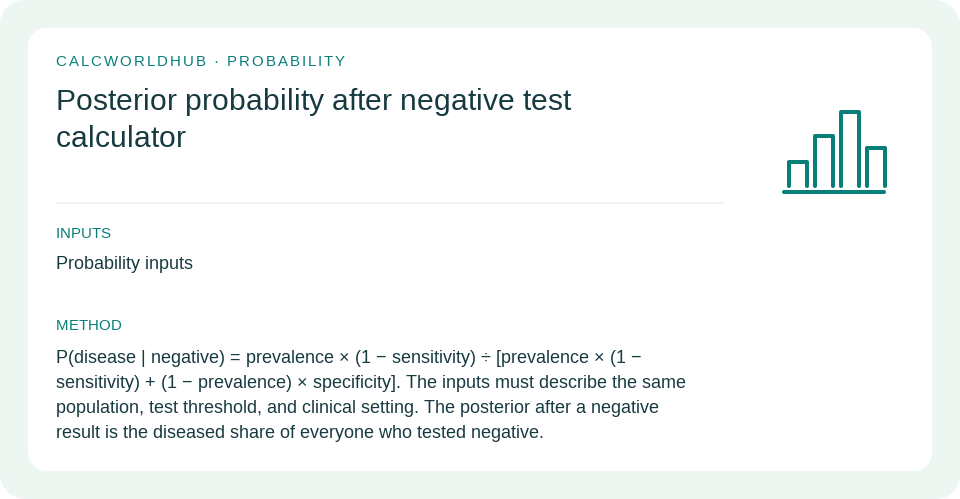
P(disease | negative) = prevalence × (1 − sensitivity) ÷ [prevalence × (1 − sensitivity) + (1 − prevalence) × specificity]. The inputs must describe the same population, test threshold, and clinical setting.
Worked example
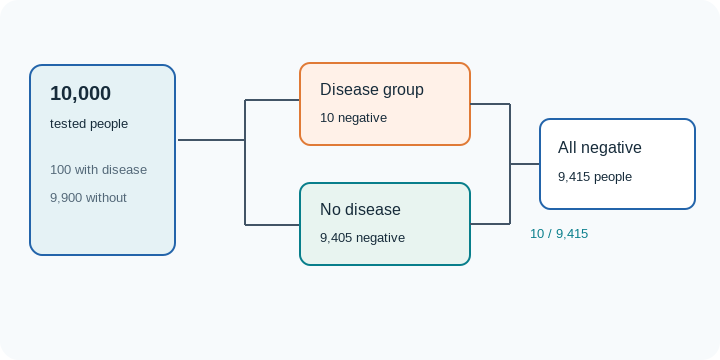
In 10,000 people at 1% prevalence, 100 have the condition. At 90% sensitivity, about 10 of them test negative. Of 9,900 without the condition, 95% specificity gives 9,405 true negatives. The negative-result group contains about 9,415 people, so 10 ÷ 9,415 ≈ 0.1062%.
Interpreting the result
The result is the estimated fraction with the condition among people who receive a negative result under the supplied rates. Low prevalence can make this posterior probability small even when a test is reasonably sensitive.
Assumptions and limits
This is a population calculation using fixed test characteristics. It does not diagnose or rule out disease for a person, and test performance can differ by setting, threshold, patient mix, and confirmatory pathway.
Sources and method notes
Frequently asked questions
Why can a negative result still leave some probability?
Sensitivity below 100% allows false negatives. The remaining probability also depends on how common the condition was before testing.
How do I use the Posterior probability after negative test calculator?
Complete the labeled inputs for Posterior probability after negative test. Use the units requested by each field, then read the displayed result alongside the method and limits below.
What is a worked example of Posterior probability after negative test?
In 10,000 people at 1% prevalence, 100 have the condition. At 90% sensitivity, about 10 of them test negative. Of 9,900 without the condition, 95% specificity gives 9,405 true negatives. The negative-result group contains about 9,415 people, so 10 ÷ 9,415 ≈ 0.1062%.
What does the Posterior probability after negative test calculator calculate?
Estimate disease probability after a negative test from prevalence, sensitivity, and specificity using Bayes’ rule.
What assumptions apply to Posterior probability after negative test?
This is a population calculation using fixed test characteristics. It does not diagnose or rule out disease for a person, and test performance can differ by setting, threshold, patient mix, and confirmatory pathway.
Read our calculation methodology.