How to use this calculator
Estimate the dimensionless Nusselt number from a convection coefficient, characteristic length, and fluid conductivity.
- Enter Convective heat-transfer coefficient h, Characteristic length L, Fluid thermal conductivity k_f. Match the units shown beside each field and review the result together with the assumptions below.
- Read the worked example below to check the expected input format and result.
- Compare another scenario by changing one input at a time. Use Reset to return to the starting values.
How this calculation works
The Nusselt number compares convective heat transfer at a surface with conduction through a fluid layer of the selected length. Engineers use it to express convection-correlation results without units; this ratio is not itself a heat rate or a universal heat-transfer coefficient.
Inputs and units
heatTransferCoefficient— Convective heat-transfer coefficient h- Surface convection coefficient in watts per square metre-kelvin (W/(m²·K)).
characteristicLength— Characteristic length L- Length scale appropriate to the selected geometry, in metres (m).
fluidConductivity— Fluid thermal conductivity k_f- Thermal conductivity of the flowing or surrounding fluid in watts per metre-kelvin (W/(m·K)).
Formula
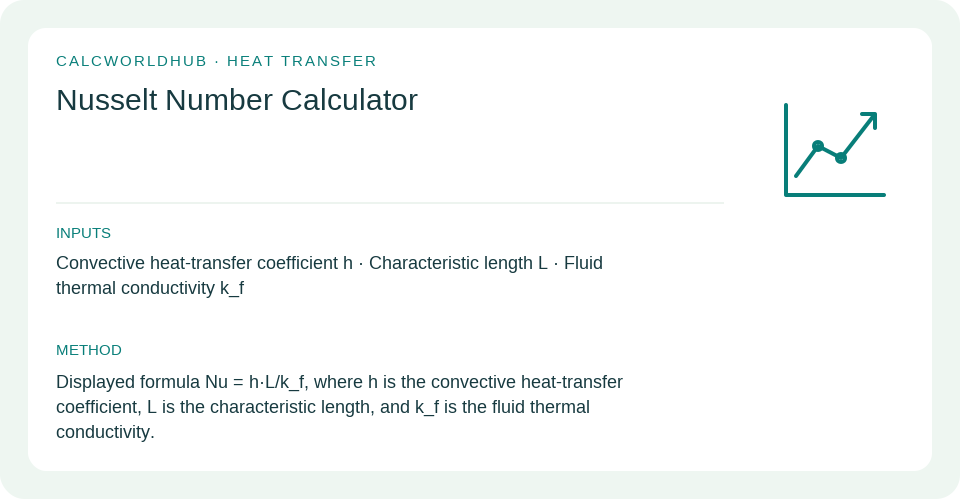
Nu = h·L/k_f, where h is the convective heat-transfer coefficient, L is the characteristic length, and k_f is the fluid thermal conductivity.
Method
Multiply the entered convection coefficient by the chosen length, then divide by the fluid conductivity. Keep all properties and length in the listed SI units so the result is dimensionless.
Worked example
For h = 25 W/(m²·K), L = 0.050 m, and fluid conductivity k_f = 0.60 W/(m·K), Nu = 25 × 0.050 / 0.60 ≈ 2.0833.
Assumptions and limits
Use a coefficient, fluid conductivity, and characteristic length that refer to the same surface, fluid, and flow condition. The calculator does not select a correlation, infer a missing coefficient, or predict heat rate; geometry, flow regime, and boundary conditions still govern whether a reported value is useful.
Frequently asked questions
What does a Nusselt number compare?
It compares convection at a surface with conduction across a fluid layer using the chosen characteristic length.
Which length should I enter?
Use the length specified by the geometry and correlation you are applying, such as a plate length or tube diameter.
Does this calculator predict heat transfer rate?
No. It evaluates Nu from an entered coefficient; finding heat rate also needs area and a temperature difference.
Can I use the result to choose any convection correlation?
No. Correlations have geometry, flow-regime, and property-range assumptions that must fit the physical case.
How do I use the Nusselt Number Calculator?
Enter Convective heat-transfer coefficient h, Characteristic length L, Fluid thermal conductivity k_f. Match the units shown beside each field and review the result together with the assumptions below.
Reference: MIT A Heat Transfer Textbook definition of the Nusselt number as hL/k for the fluid. See our calculation methodology.