How to use this calculator
Estimate nominal battery energy and amp-hour capacity from daily load, autonomy, efficiency, and depth of discharge.
- Enter Daily AC energy use (kWh/day), Autonomy (days), Inverter efficiency (fraction), Maximum depth of discharge (fraction), then complete the remaining labeled fields. Match the units shown beside each field and review the result together with the assumptions below.
- Read the worked example below to check the expected input format and result.
- Compare another scenario by changing one input at a time. Use Reset to return to the starting values.
How this calculation works
Battery sizing works backward from the energy the loads need over the chosen autonomy period. Dividing by inverter efficiency and allowable depth of discharge estimates the nominal battery capacity required before additional temperature, aging, and reserve design margins are considered.
Inputs and units
daily— Daily AC energy use (kWh/day)- Total energy the battery-backed AC loads need each day.
days— Autonomy (days)- Days the load should run without charging input.
efficiency— Inverter efficiency (fraction)- Enter a fraction from 0 to 1, such as 0.90 for 90%.
dod— Maximum depth of discharge (fraction)- Usable share of nominal battery energy; follow the battery maker's limit.
voltage— Battery bank voltage (V)- Nominal DC bus voltage used to express the energy as amp-hours.
Formula
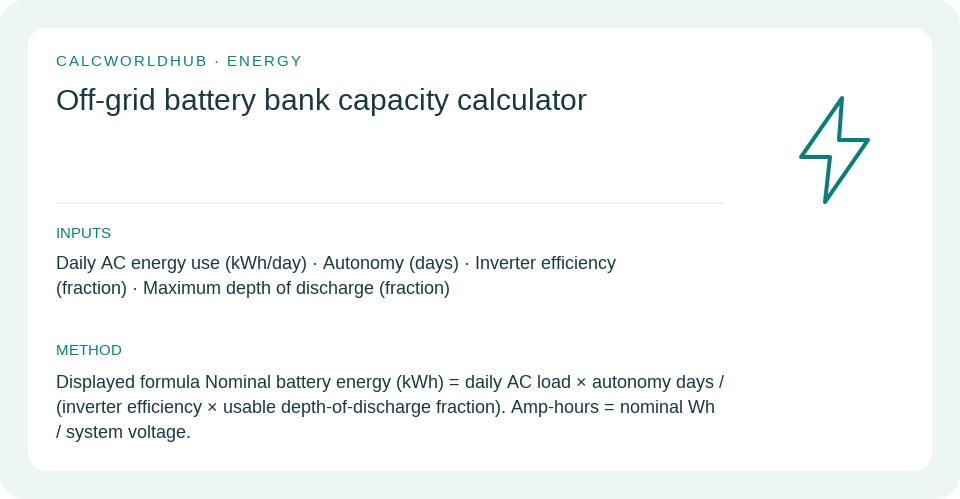
Nominal battery energy (kWh) = daily AC load × autonomy days / (inverter efficiency × usable depth-of-discharge fraction). Amp-hours = nominal Wh / system voltage.
Method
Enter daily energy delivered to AC loads in kWh, autonomy in days, inverter efficiency as a fraction, maximum planned depth of discharge as a fraction, and DC bus voltage. The result is an energy capacity estimate and its idealized amp-hour equivalent.
Worked example
For 10 kWh/day, two days of autonomy, 90% inverter efficiency, and 80% depth of discharge, nominal storage is 20/(0.9×0.8) ≈ 27.78 kWh. At 48 V, that is about 579 Ah.
Assumptions and limits
This estimate omits battery temperature, aging, rate-dependent capacity, DC loads, wiring losses outside the entered efficiency, surge power, charge-source sizing, and manufacturer limits. Use the chemistry and operating limits specified by the battery supplier and have a qualified designer verify an installation.
Frequently asked questions
Why is nominal battery capacity larger than daily energy use?
The bank must cover multiple autonomy days and losses while staying within the allowed depth of discharge.
Should I use DC or AC energy consumption?
Enter AC load energy if inverter efficiency is included; use the matching efficiency boundary for your system.
Does the amp-hour result specify a battery configuration?
No. It converts estimated energy to Ah at the entered voltage but does not choose series/parallel modules or check current limits.
Does this include reserve for aging or cold weather?
No. Add design margins using the battery manufacturer's data and project conditions.
How do I use the Off-grid battery bank capacity calculator?
Enter Daily AC energy use (kWh/day), Autonomy (days), Inverter efficiency (fraction), Maximum depth of discharge (fraction), then complete the remaining labeled fields. Match the units shown beside each field and review the result together with the assumptions below.
Reference: Victron Wiring Unlimited battery-system design reference. See our calculation methodology.