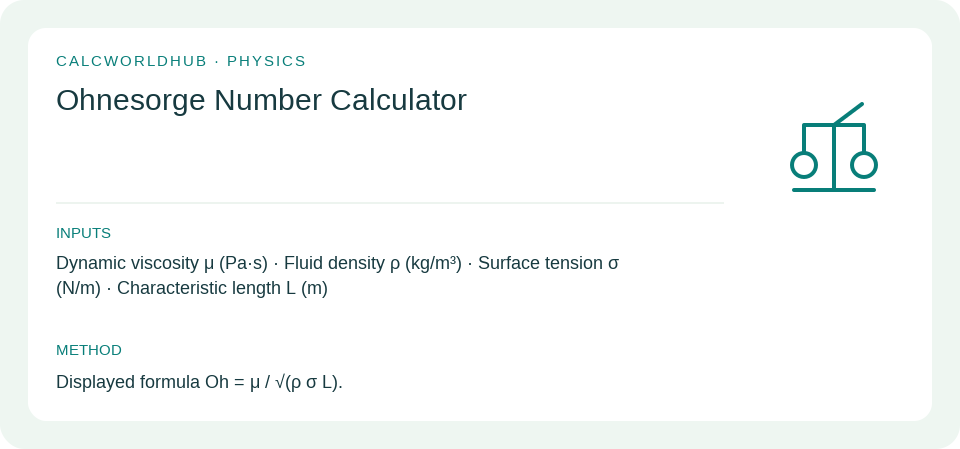
How to use this calculator
Compare viscous effects with inertia and surface tension for a fluid using the Ohnesorge number.
- Enter Dynamic viscosity μ (Pa·s), Fluid density ρ (kg/m³), Surface tension σ (N/m), Characteristic length L (m). Match the units shown beside each field and review the result together with the assumptions below.
- Read the worked example below to check the expected input format and result.
- Compare another scenario by changing one input at a time. Use Reset to return to the starting values.
How this calculation works
The Ohnesorge number is a dimensionless measure used in free-surface flows, jets, and droplet breakup.
Inputs and units
viscosity— Dynamic viscosity μ (Pa·s)- Dynamic viscosity of the liquid at the modeled condition.
density— Fluid density ρ (kg/m³)- Mass density of the fluid at the modeled condition.
surfaceTension— Surface tension σ (N/m)- Liquid–gas surface tension at the modeled condition.
length— Characteristic length L (m)- Length scale selected for the free-surface or jet problem.
Formula
Oh = μ / √(ρ σ L).
Method
The calculator uses dynamic viscosity μ, fluid density ρ, surface tension σ, and a characteristic length L in coherent SI units. The length convention should match the flow problem; for jets and drops, authors may use a diameter or another stated scale.
Worked example
For water near 20 °C with μ = 0.001002 Pa·s, ρ = 998.2 kg/m³, σ = 0.0728 N/m, and L = 1.00 mm, Oh ≈ 0.00372.
Assumptions and limits
The result depends on the chosen characteristic length and on the fluid properties at the relevant temperature and composition. It is a dimensionless group, not a direct prediction of breakup or printability thresholds.
Frequently asked questions
What does a larger Ohnesorge number indicate?
Viscous effects are stronger relative to the inertia and surface-tension scales represented by the selected length.
Should I use a radius or a diameter?
Use the characteristic length defined by the model or paper you are comparing with; different conventions change the numerical value.
Does Oh alone determine whether a liquid can be jetted?
No. Jetting also depends on geometry, operating conditions, and other flow groups; this calculator reports Oh only.
How do I use the Ohnesorge Number Calculator?
Enter Dynamic viscosity μ (Pa·s), Fluid density ρ (kg/m³), Surface tension σ (N/m), Characteristic length L (m). Match the units shown beside each field and review the result together with the assumptions below.
What is a worked example of Ohnesorge Number?
For water near 20 °C with μ = 0.001002 Pa·s, ρ = 998.2 kg/m³, σ = 0.0728 N/m, and L = 1.00 mm, Oh ≈ 0.00372.
Reference: MIT free-surface-flow notes relating the Ohnesorge, Reynolds, and capillary groups. See our calculation methodology.